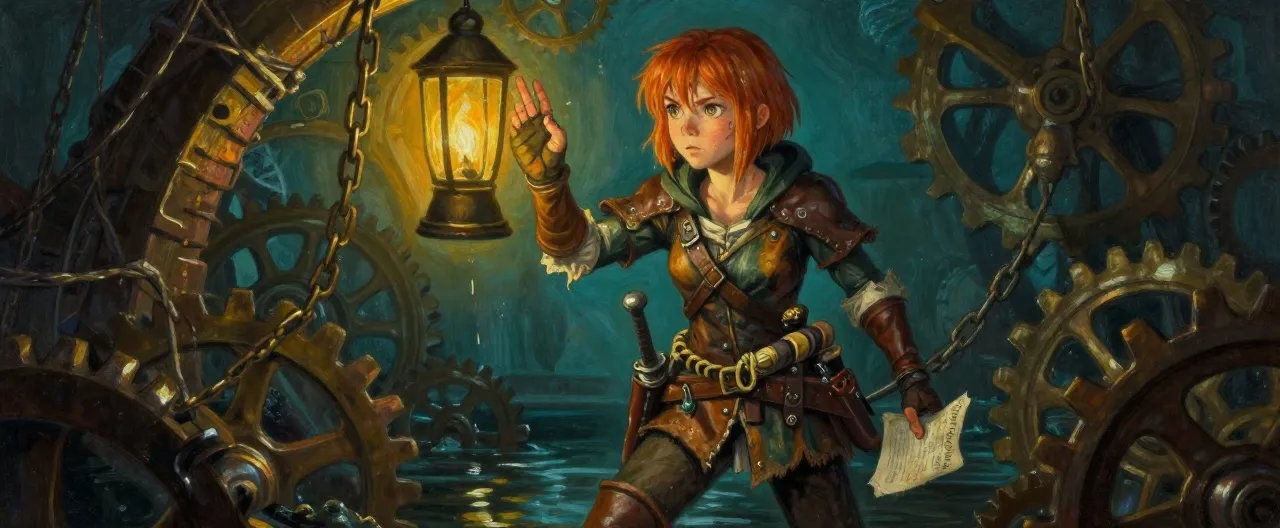
Pindle Vex was born in the third level of the Sump Gears, in a lean-to built against the housing of a drowned governor, to a mother who kept records and a father nobody mentions. Her mother worked the keeping-stations — the undercity's unofficial archive of key-bolt frequencies, maintained by keepers who scratched their tallies in private ciphers on brass slates — and taught Pindle the tally-marks as a game before Pindle could read common.
It was the only inheritance that mattered. When Pindle was six, her mother drowned in the flooded station under the third lift, or so everyone said, and Pindle went into the Crew's economy like a coin into a purse: message-running at eight, purse-cutting at twelve, indentured on paper the Crew held and she did not.
The pressing was not random, though Pindle would not learn that for years. A buyer paid the runner who kept the tally-book for her name specifically — why, no one in the Crew's lower ranks knew, and Grizel, who collected her finder's fee, was not talking. Pindle ran the Crew's errands for six years and cut its purses for four more, and the whole time she kept a private ledger of her own: every debt she owed, every debt she was owed, every favour with a price and every price with a name.
It was a survival habit that became a philosophy. She repaid Old Sarn the lamp-oil seller within the month. She left a marker with the ferryman Dredge. She paid the widow Brack's protection toll when the widow's own people wouldn't. Half the Sump Gears knows Pindle Vex settles up, and that reputation is worth more down there than coin.
She escaped the Crew the way she does everything — fast, in the dark, and with a cost she doesn't talk about. The runner who held her tally-book went with her to the strongroom where the paper was kept, and when the diversion came, Pindle locked him in the flooding room and took the only copy of her indenture she could reach: the one folded in her boot, not the one in the Crew's strongbox. She has never learned whether he drowned. She counts exits when she can't sleep.
The Crew, naturally, did not accept the arrangement. Grizel hunts her on principle — a debt unpaid is a challenge to the whole undercity's order — and the Crew's cells on two rings have her description. But Pindle has assets the Crew can't price: Tick, the twelve-year-old guide who has decided Pindle is the person who will bring their brother Cog home from the unkeying engine; the keeping-station records only she can read, because the cipher is her mother's; and now a fragment of the unkeying engine's manifest, lifted from a Crew runner, whose numbers match the tally-marks inside her first purse.
She does not yet understand what that last coincidence means. She suspects, correctly, that it means her mother counted the same bolts the Crew is now counting, and that the machine Marisel Quill is building was written down first in a language Pindle can read.
Her relationship to the Ratchet Crew is thus not the simple enmity of a victim and her oppressors but something more uncomfortable: she grew up inside it, she knows its cant and its hand-signs and its laundry marks, she can walk into a Crew safehouse and be half-invisible, and part of her — the part that finds Grizel's throne practical — never entirely left. Her war with the Crew is also a war with the version of herself that the Crew made, and every quest she completes moves the line: the tally-book burned is her childhood freed, the debts paid are her adulthood claimed, the keeping-station found is her mother recovered.
By the time she faces the Grand Cage, the question is no longer whether she can buy her name back but what she will do with a self that no longer needs buying — and whether the girl who locked a man in a flooding strongroom can live with the woman who walks out of the Sump Gears owning herself.