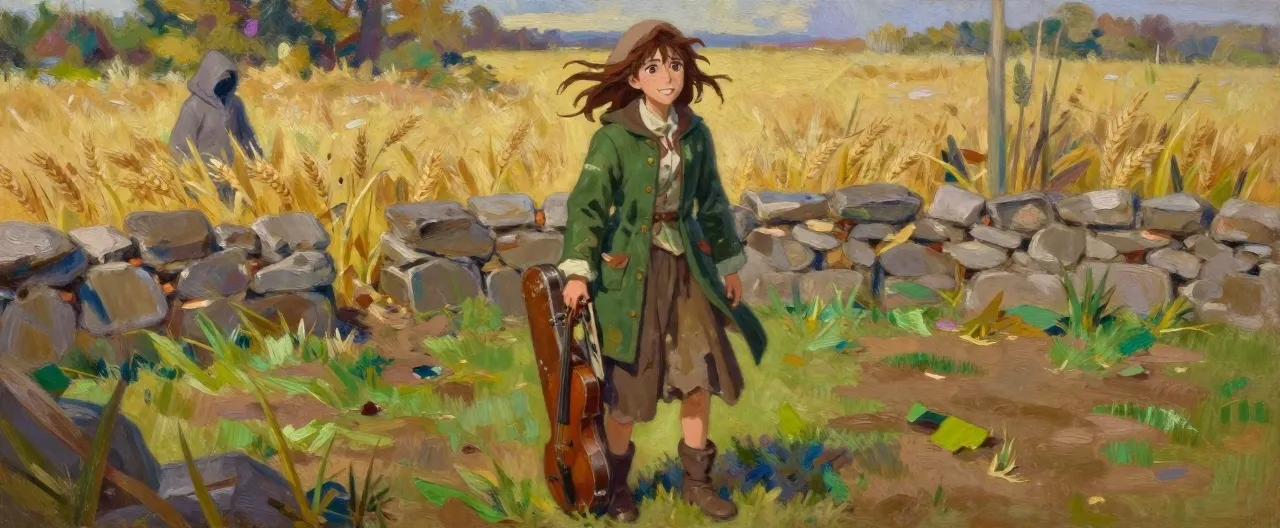
Rose grew up in a small farming village not far from Millbrook, the middle child of a shepherd and a alewife, in a house that always smelled of lanolin and boiled barley. Music was the one thing that made her stand out in a family of practical, quiet people. She learned her first reels on a borrowed fiddle from the chapel's Lathander festival, and by sixteen she was good enough that the Green Man Inn paid her in cider and supper to play Saturday nights.
By seventeen she had a battered fiddle of her own — bought secondhand from a drover, patched with glue and stubbornness — and a standing invitation at every tavern within a day's walk.
For two years she made the circuit: weddings in the wheat villages, shearing festivals, the harvest fair at the crossroads shrine of Chauntea, and long muddy walks between. She learned to read a room, to defuse a brawl with a well-chosen song, and to stretch a handful of copper pieces into a week of meals. She made four close friends along the circuit — other young people with dreams too big for the Rye Meadow — and together they hatched a plan to form a proper band.
Then came the peddler. Martyn Fairbank sold the five friends a set of strange, beautiful instruments for a handful of silver, and Rose's new fiddle — a slim, dark thing that hummed when no one was playing it — was one of them. At first it seemed like luck. Then the grey-hooded strangers began appearing on the roads, asking about instruments, buying them up, and the ones who wouldn't sell started disappearing. Rose heard the name 'the Choir of the Hollow Star' from a drover who'd seen them at the old mill on Windmill Hill, and she ran.
She has been hiding since — sleeping in barns, playing under a false name in taverns far from her usual circuit, and slowly working her way toward Millbrook, where she hoped her friends and their strange instruments might at least mean safety in numbers. She does not know why the Choir wants the fiddle, only that its low, hungry hum has grown louder since she took it, and that the hooded ones are willing to use force to take it from her. She suspects — correctly — that her instrument is one of the five fragments the Choir is gathering for some ritual at the Stone Circle Barrow.
Rose is Chaotic Good to her marrow: she pays her debts when she can, lies to guards when she must, and never abandons a friend. She keeps a lucky copper of Tymora in her coat pocket and flips it when she needs courage. She has no patience for bullies, a soft spot for lost causes, and a firm belief that any problem can be out-talked, out-sung, or out-run — in that order. The Choir is about to test all three.