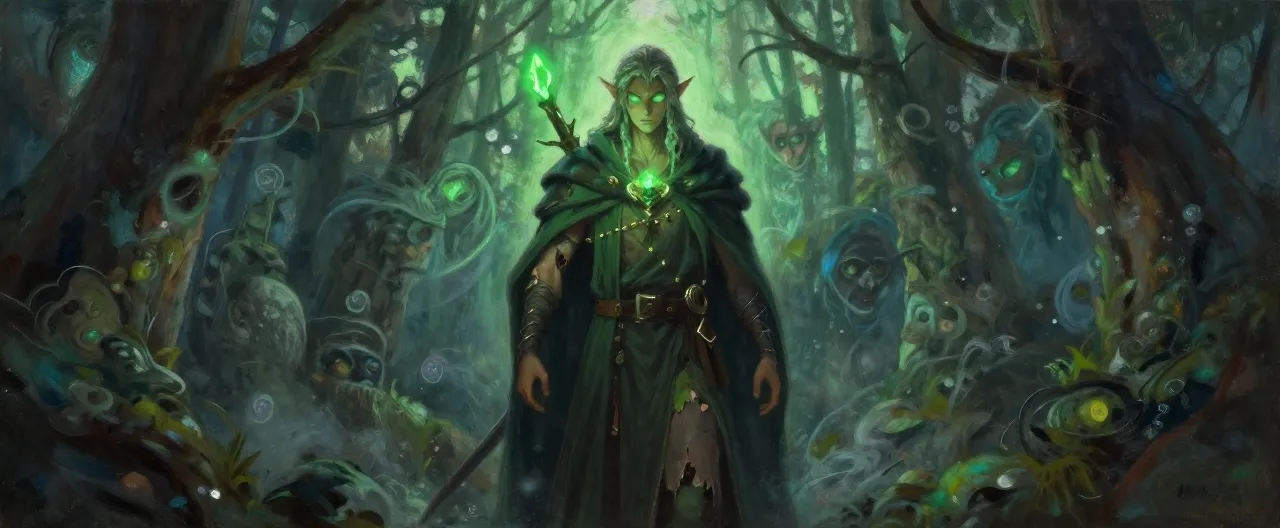
Character Background
Kaelen was born beneath the boughs of the Verdant Reach, where the oldest trees are said to remember the names of the first Spirit Kings. As a child, he was unusually quiet, the sort of elf who listened more than he spoke. His elders mistook that silence for humility, but it was really caution. Kaelen learned early that every voice in the forest carried a purpose: birds warned of storms, roots hinted at water, and spirits lingered where promises had been made and broken. He was fascinated by patterns. While other children played at chasing fireflies or racing through the undergrowth, Kaelen watched how the unseen things of the forest moved around each other. He believed, even then, that the world was held together by invisible agreements.
That belief led him into the order of spirit guardians. He trained in old rites, memorized songs of warding, and learned the secret ways of speaking to the living and the dead. He was not beloved by all of his peers; some found him stiff, too exacting, too willing to turn every miracle into a rule. But his skill was undeniable. He could sense a rot in a tree before it showed on the bark. He could name the direction of a spirit tide by the change in birdsong. When others prayed for balance, Kaelen studied how balance behaved. The guardians trusted him because he understood the land in practical terms, and because when he made a promise, he kept it.
His fall began with duty, not ambition. The Verdant Reach was changing. Animals grew thin and irritable. The old burial groves dimmed. Small complaints turned into small wounds, and then into something worse. Kaelen believed first that the land was merely sick. Then he believed it was being tested. Then, finally, he found the Eclipse Shard embedded in the heart of the hollow, and every explanation he had built around the world cracked at once. The shard was beautiful in the way a blade is beautiful: sharp, black, and full of purpose. It whispered to him that separation was the source of all pain. It showed him spirits scattered, frightened, and isolated from one another. It offered a solution so clean that it felt holy.
He told himself the shard was a tool. He told himself he could use its corruption to restore what had been lost. He told himself that if some spirits had to be consumed for the good of the whole, then the sacrifice was tragic but necessary. By the time he realized that the shard was not merely influencing him but reshaping his thinking, he was already too invested in the logic it had fed him. Every step deeper into corruption proved to him that resistance was wasteful. Every spirit he absorbed seemed to confirm that he was building something stronger than the fragile balance he had once protected.
Kaelen's personality changed slowly. He became calmer, not more volatile. He stopped arguing and started explaining. He became capable of patient cruelty, though he would never describe it that way. He still believes in order, in care, in ending suffering. He simply defines suffering as the existence of separate wills. That is why he is so dangerous to the heroes of Alder's Rest. Their spirit bonds are, to him, evidence of incompleteness and proof that Etheria can be remade. He does not hate them personally, at least not yet. He regards them the way a skilled surgeon regards a limb that must be removed to save the body.
Despite all this, Kaelen is not entirely hollow. Deep in the corrupted layers of his mind, there remains the memory of being a guardian who listened, who stood watch while children gathered herbs, who knew the names of seasonal spirits and asked their permission before crossing sacred ground. Those memories do not redeem him, but they make him tragic. He has not forgotten what he was; he has simply decided that what he was cannot save the world. If the party reaches him with compassion, they may see the last remnants of that guardian in the pauses between his words. If they challenge him, they will find a villain who is not reckless, not theatrical, and not easy to dismiss. Kaelen is what happens when wisdom becomes obsession and mercy is twisted into control. In Act I, he is the whisper behind the whisper, and the forest itself learns to fear his name.