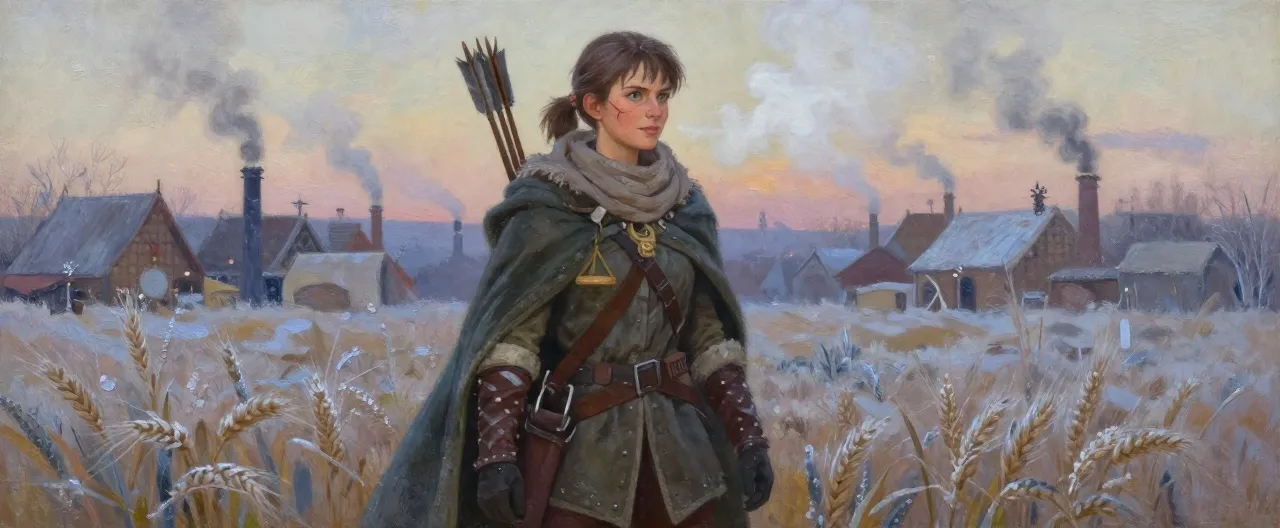
Sylvia Clearbrook was born in a hamlet upriver from Brightwater, the third of five children of a barley farmer and a woman who mended nets. The northern reach of the Rye Meadow country is hard country in a good year, and Sylvia learned early that winter doesn't negotiate. She learned to shoot at nine because her father couldn't afford to lose sheep to wolves, and she learned to read tracks at eleven because the wolves learned to read fences.
She left home at sixteen, following a recruiter's promise of honest wages and finding instead the shadow trade. For six years she worked as a bounty runner — tracking debt-jumpers, deserters, and the occasional genuine criminal across the northern baronies — under a fixer named Harl Upton, who taught her that the difference between a bounty hunter and a criminal is mostly paperwork and who's paying. She got good at it: good at reading soft boot prints, good at waiting three days in a snowbank, good at slipping into places she wasn't meant to be. She also got good at seeing what happens to desperate people when the law comes for them, and it sat worse with her every year.
The scar came from a job outside the hills — a mark who turned out to be a desperate father, not a thief, and whose cousin put a knife through her eyebrow before she could lower her bow. She took the coin anyway. She didn't take the next one.
Two winters ago she walked away from Harl's crew after a job went wrong and a man she'd caught died of cold in a cellar she'd locked him in. She carried the guilt south, took honest work guiding fur traders, and started putting copper at the little shrine to Kelemvor in every town she passed — the Lord of the Dead judges fairly, and Sylvia wants to be judged fairly when her time comes. She's been going straight for two years, though her old skills haven't rusted, and neither have her old enemies.
She was drinking in the Brightwater Arms when the frost came — she'd guided a trader north that autumn and was wintering over before the return trip. When the mill-wheels froze and Mary Whitmore started hiring, Sylvia listened to the talk in the common room: a bell in the hills, a dead man ringing it, a company that went out and never came back. She'd heard the bell herself once, on a night hunt two years back, and told herself it was the wind.
She took the job for three reasons. First, the frost is killing the country her family still farms, and she won't watch that from an inn. Second, the missing company might still have someone alive out there, and she knows what a locked cellar in winter means. Third — and she'd admit this to no one but Kelemvor — she owes the dead a debt, and a lich who rings bells that drink the warmth from the world seems like a fine place to start paying it down.
She prays quietly to Kelemvor, keeps her blade sharp, and trusts her bow more than her words. She's been lied to by professionals. A dead man with a courteous smile won't fool her — but what he wants her to do in the cold beyond the portal, that's a question she intends to survive long enough to answer.