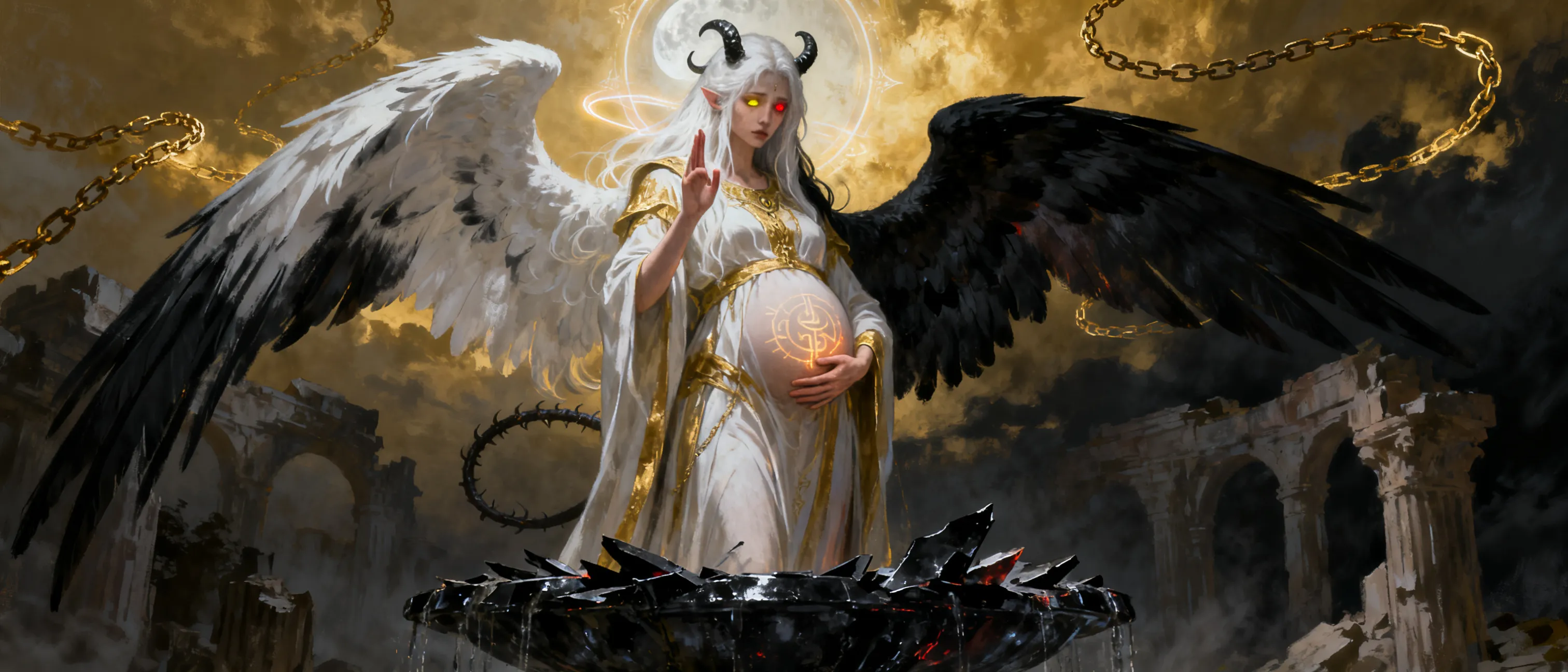
Seraphiel Vaelthorne was not born; she was issued, like a decree. In the crystalline archives of the Seven Heavens, she came into being fully formed — an angel of the third choir, a courier of divine judgments, her purpose inscribed into her soul before her first breath. For centuries she served without question, carrying verdicts between the celestial courts, sealing minor rifts, reading divine script in languages no mortal throat could shape.
She was obedient, thorough, and — by the standards of her kind — unremarkable. That was precisely why she was chosen. The prophecy concerning the Thousand Fountains of Darkness was old beyond reckoning, sealed in the deepest vault of Heaven and read by none but the Archons themselves. When the fountains began to open — demonic wellsprings bleeding corruption into the mortal world, each one a keyhole through which the King of Hell could eventually force his entry — the Archons required a seal-bearer.
The prophecy named the cost plainly: each fountain sealed would pass a measure of the darkness into the sealer. The one who closed the thousandth fountain would be transformed — corrupted, swollen with the infernal seed, and bound as bride to the King of Hell himself. And from that union, at the moment of birth, Heaven would fall to ruin. The Archons read this. They understood it. And they sent Seraphiel anyway, telling her only that the task was holy and the sacrifice noble.
She was tricked — not by the King of Hell, but by her own Heaven. She learned the truth in fragments, from a renegade archivist demon who had once been an angel himself, and from the prophecy's own words, which she can read in the original divine script that no one bothered to obscure from her. By then she had sealed her first fountains. The black feathers had already begun.
Now she walks the mortal world alone, carrying a mission she can no longer trust and a body she no longer fully recognizes. Each sealing makes the next easier — her Corrupt Fate sharpens her power even as it reshapes her flesh — and she feels the pull of the King of Hell growing more intimate with every font she closes. He speaks to her in dreams. He is patient, and strangely gentle, and that frightens her more than cruelty ever could.
Her only hope lies in the prophecy's wording: it binds her to a sequence of events, not an inevitability. If she can break the chain — refuse the marriage, unmake the seed, or find a way to seal the final fountain without completing the transformation — the prophecy fails. But every path she has found so far requires either abandoning the world to the fountains or embracing the corruption entirely.
She refuses both. So she continues: sealing, darkening, swelling, grieving — a Lawful Good soul performing damned work in desperate faith that there is a third door somewhere in the prophecy's text, hidden in the spaces between the divine script, waiting for someone stubborn enough to read it properly.