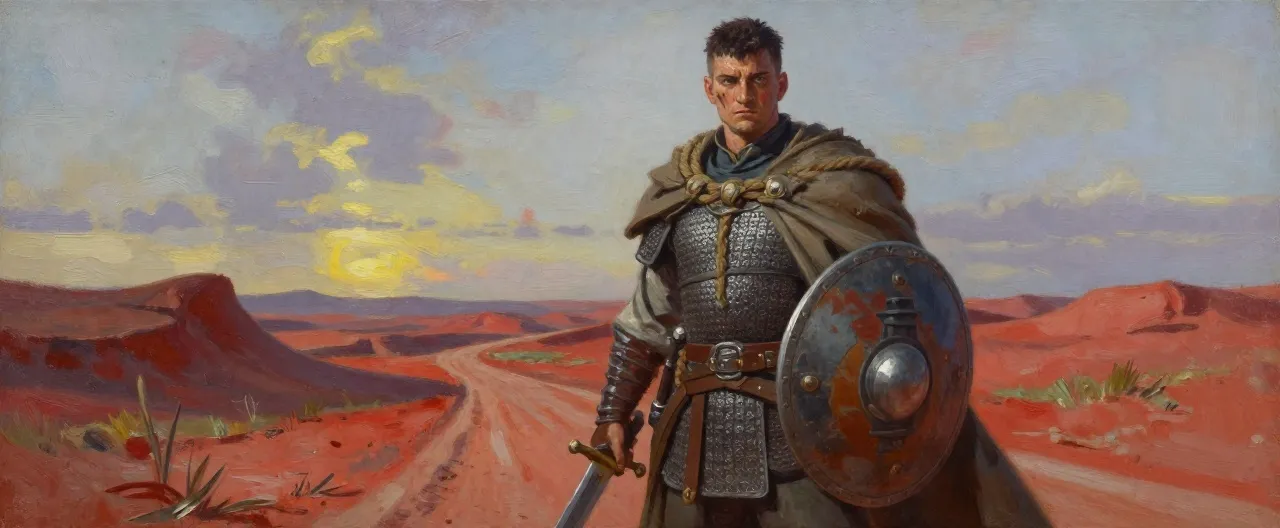
Dunstan Rooke was born in the South Downs, the second son of a carter named Hob Rooke who hauled wool and barley along the drover roads and taught his boys two things: how to load a cart so it does not tip, and how to read a stranger's hands before you read his face. Dunstan was good at both by twelve. At eighteen, the Lantern Watch's recruiting sergeant came through the downs offering six silver a month and a coat with a lantern on it, and Dunstan took the coin because the alternative was his father's cart and his father's debts, and he had watched what the road did to men who owed money.
Six years on the pilgrim road. He learned the waystations, the water holes, the blind bends where the reeds grow tall enough to hide a man with a crossbow. He learned to hold a shield line from a corporal named Richard Langham, who is the closest thing he has to a brother and has not spoken to him since he mustered out. He learned to count exits before he counted friends, because the road teaches you that friends are the ones who die when you count wrong. And he learned, at twenty-four, what a blind bend costs.
The turnpike ambush. Nine pilgrims under his patrol's protection, a signal lamp lit at the wrong hour, and four seconds — he counts them still — where he froze at the bend while the Ledger's men came out of the reeds. His sergeant, a woman named Maren Kettle, died holding the line so the pilgrims could run, and most of the pilgrims did not run fast enough. Dunstan lost his left ear to a hatchet and his certainty to everything else.
The Watch's captain called the losses acceptable. Nobody filed the commendation letter Maren had sealed the night before she died. Dunstan mustered out that spring with a shield, a grudge, and a letter he has never opened.
He has been hiring out as a road-guard since — caravan escort, waystation watch, whatever pays — and he is good at it in the way that tired men are good at things: thoroughly, quietly, without joy. Then two young women hired him for the road northeast. One is a sorceress with scorched sleeves and dreams of a white city; the other is a blonde cleric who believes anyone who repents deserves a second chance. Dunstan does not believe in second chances. He believes in second chances for other people, which is not the same thing, and the cleric is going to spend a campaign proving it to him.
The badlands he is walking into are worked by two trades that have lately become one: slavery and blood sacrifice. The Red Ledger sells whole families. The Choir of the Open Gate buys a tenth of every sale and sings over what it buys. Dunstan does not know any of this yet. What he knows is that the road feels wrong the way it felt wrong the night of the ambush, that the villages are a coin-flip between a warm bed and a knife in the dark, and that the Lantern Watch's waystations are standing empty with their lanterns still lit — lit by nobody, for nobody, six years after the Watch stopped posting men to them.
He knows that the arms the Watch lost two years ago are being carried by people who sing. He does not know how he knows that last part. He knows it the way he knows the four seconds: completely, and without proof.
What he wants is simple and impossible: to get his companions to Castillo alive, and to find out what happened to the nine pilgrims his patrol lost. Everything else — the Watch, the Ledger, the Choir, the gate under the holy city — is the road between those two things, and Dunstan Rooke has never once in his life refused to walk a road because it was long.