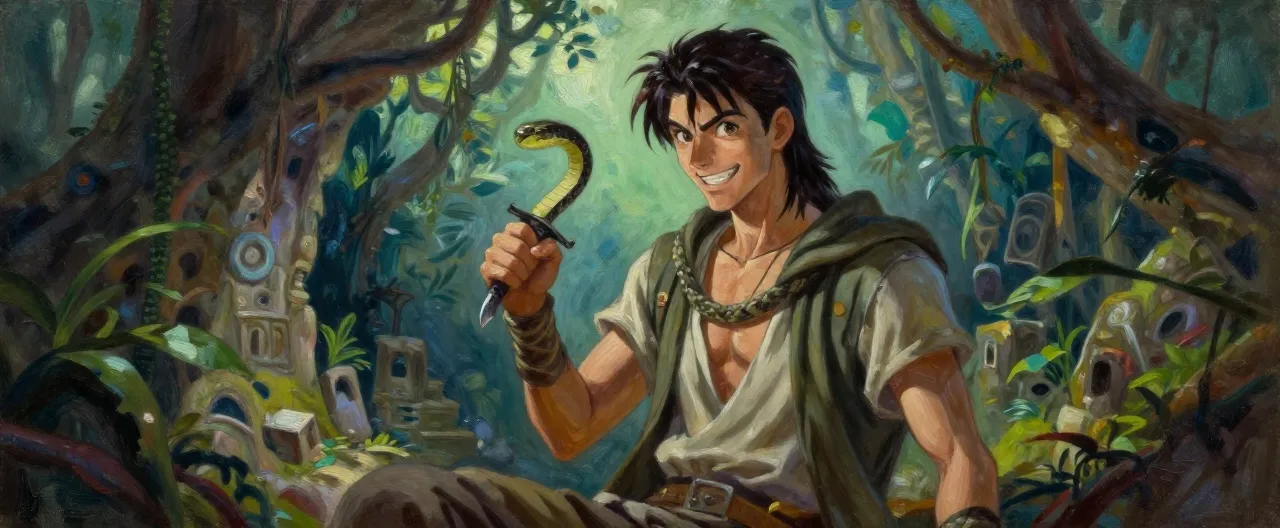
Malakai grew up in the borderlands where law was thin, survival was a trade, and a promising lie could be more valuable than a blade. He learned early that the people who lasted were not always the strongest or kindest, but the ones who could read a room, predict desperation, and turn attention into advantage. As a child, he was never the biggest or the fastest. He was the one who knew which merchant was cheating the scale, which guard could be distracted, and which insult would make a rival swing first. Adults mistook that talent for charm. In truth, it was a survival skill born from a home where kindness was unreliable and hunger was common.
He drifted into petty crime as a teenager, not because he loved the work, but because it rewarded what he already did well: deception, timing, and the ability to talk his way out of consequences. He learned the value of hidden doors, blackmail, poison in a handshake, and the comfort of having someone else take the blame. When caught, he never endured punishment with dignity. He bargained. He cried if it helped.
He promised loyalty he did not feel. If a friend or accomplice had to be sacrificed to keep his own skin intact, he considered that good business. Each time he survived by betraying someone, he became a little more convinced that betrayal was not a failure of character but a law of the world.
Eventually, that talent drew the attention of the Ashen Circle. They did not recruit him for virtue or devotion. They recruited him because he could be made useful. Malakai likes to imagine he impressed them with intelligence, but the truth is more humiliating: he was noticed because he was easy to use. He knew how to move between markets, shrines, and local smugglers without attracting attention. He could talk to priests with false reverence, to bandits with a crooked grin, and to frightened locals with just enough threat to keep them quiet.
The Circle gave him a purpose that looked like status and a rank that looked like importance. He accepted immediately, because to him it felt like proof that the world had finally recognized his value.
That recognition never fully came. He was useful, but not trusted. He was assigned errands, recoveries, and quiet errands that ended with other people buried, missing, or blamed. The more he learned about the Circle, the more he realized it treated agents like scalpels: valuable while in hand, discarded when dull. Rather than recoil, he simply adjusted. He told himself that if he could bring back enough relics, enough secrets, enough victories, then no one would dare replace him.
The Heartwood Idol became his chance to make that belief real. He was sent to retrieve it, but in his mind that mission became a test. If he could succeed, perhaps he would no longer be a disposable mouthpiece. Perhaps he could become someone whose name mattered.
That dream is the closest thing Malakai has to a faith, and it is a rotten one. He is not loyal to the Ashen Circle in any meaningful sense. He is loyal to the possibility that power will protect him from insignificance. If the Circle applauds him, he will smile. If it threatens him, he will betray it without hesitation. He is fully aware that he is a coward; he simply believes cowardice is rational when the alternative is dying for principles that do not pay.
Around cultists, Malakai acts like a cultivated superior because he needs them to obey quickly and without thought. Some are loyal. Most are afraid. He encourages both. He rewards useful obedience with scraps of approval and punishes hesitation with venomous contempt. He does not see followers as comrades. He sees them as moving cover, witnesses, and distractions. This is why he survives as long as he does. It is also why no one truly loves him, and why he will never understand the difference between being obeyed and being respected.
In battle, his instincts are the same as in life. He manipulates first, intimidates second, and flees third. He loves spells that remove choices from others, especially if they make an enemy drop a weapon, lose a turn, or stand helpless while he escapes. He enjoys the spectacle of control because it makes him feel momentarily larger than the people around him. But if a fight turns against him, vanity collapses instantly into panic. He will abandon allies, bargain with enemies, and pray to nothing in particular if it keeps him breathing.
That is what makes Malakai ideal for Act I. He is not the final answer to the mystery of the Heartwood Idol. He is the first rotten thread. Pull it, and the heroes begin to unravel the Ashen Circle's conspiracy, one lie at a time.