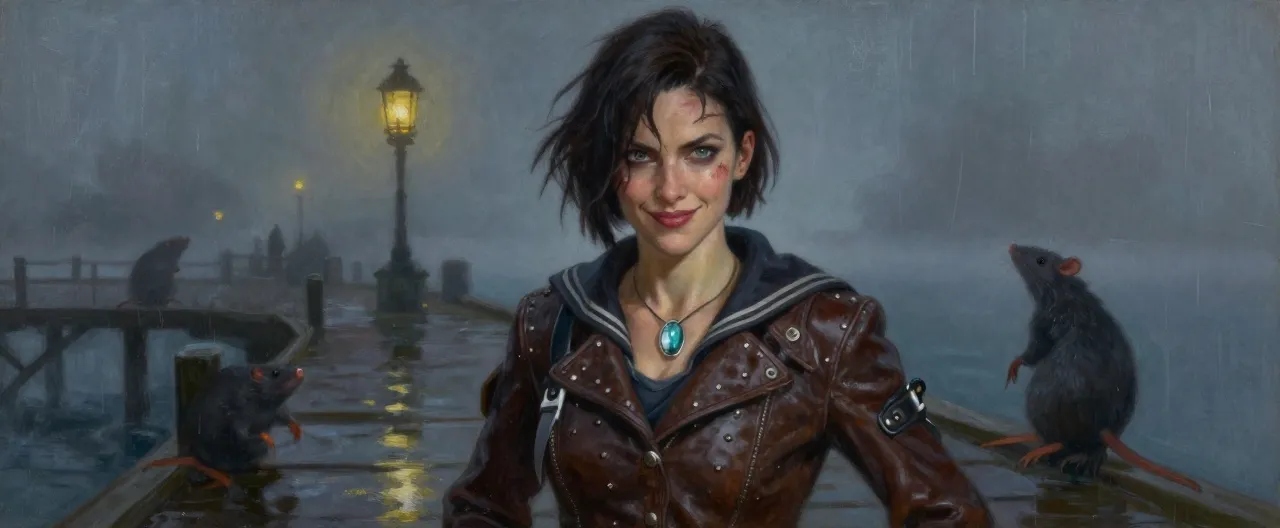
Mirelle Vantt was born in a fishmarket tenement in Ratwharf, the daughter of a widowed charwoman who cleaned the floors of the Salt Chapel and three harbor taverns for coppers, and who died of a dockside fever when Mirelle was eleven. The girl went from running messages to running cargo for the Harbor Kin before she was tall enough to see over a crate, and she learned the waterfront's true curriculum early: which guards took coin, which piers had loose boards, which warehouse foremen could be flattered and which had to be frightened.
By sixteen she had lifted Dockmaster Crane's berth-fee ledger and blackmailed a rival crew out of a pier; by nineteen she had a crew of her own; by twenty-five she ran the Harbor Kin, and the dockworkers who had known her mother called her the Harbor Whisper because she seemed to hear every conversation on the waterfront before it happened. She was, by every measure she cared about, a success: feared by rivals, bribing the Watch, owning three hidden docks, a flooded culvert beneath pier nine, and a skiff under the far pier that no one else knew existed.
Then the Weeping Sister came. Corvane's agents had approached her months before the ship arrived, offering triple pay for a no-questions cargo run, and she took it — she always took the next rung — without inspecting the hold. What she carried into her own harbor, in crates marked with her own people's signs, was the seed of the plague. By the time the rats came ashore in a line and the first coughs echoed through temple row, the Choir held her signature, her network, and her future, and Corvane Ashgrove began giving orders in the soft paternal voice of a man who has never once needed to shout.
She stole the ship's manifest to cut the paper trail; she has been burning her own warehouses to hide the supply route; and she has told herself, every night since, that she would have refused if she had known — a lie she maintains with the same skill she maintains everything else. The deal promised her the harbor after the plague: harbor mastership of a city remade, wealth beyond smuggling, the thing she has wanted since she was a child watching other people's ships.
And so she serves. She moves cult cargo through channels her own lieutenants do not question, she oversees the Choir's business on the waterfront, and she prepares to defend the ratbone staff at the Sunken Shrine because Corvane asked, softly, and the alternative to asking softly has been demonstrated to her twice. But the bargain is eating her. She regrets it — a flicker of regret she buries under charm and arithmetic — and she sees no way out, which is the truest thing about her: the Harbor Whisper, who can escape any guard, any fight, any locked room in Nostramus, cannot find the door out of her own signature on a payment ledger.
Around her, the cost accumulates in faces she knows. Liss Vell, her second, took a scar defending her and now watches her leader burn warehouses with doubt growing in her eyes. Old Pell, the one-eyed ferryman who taught her the culvert and knows about the drowning she caused a decade ago, has seen things on the ghost ship that the Choir wants silenced. Brother Ivo at the salt chapel has started noticing old Harbor Kin marks beneath the new rat sigils.
And the city she wanted to own is dying, district by district, of a sickness she delivered. If the party meets her at the Sunken Shrine, they will find her defending a ritual she despises with knives she has poisoned, and when the fight turns — as she will ensure it turns, with smoke and water and flight — the real question is not whether she can be beaten, but whether anyone has ever offered her a door instead of a blade.
She can be redeemed: the manifest, the confession to Pell, the ledger page from the chapel, the flicker of regret — all of it is a woman halfway back already, waiting for someone to make the offer her pride would never let her ask for. Otherwise, she dies a smuggler's death: in the smoke, in the water, smiling, with the ring still on her finger and the harbor she wanted going to someone else.