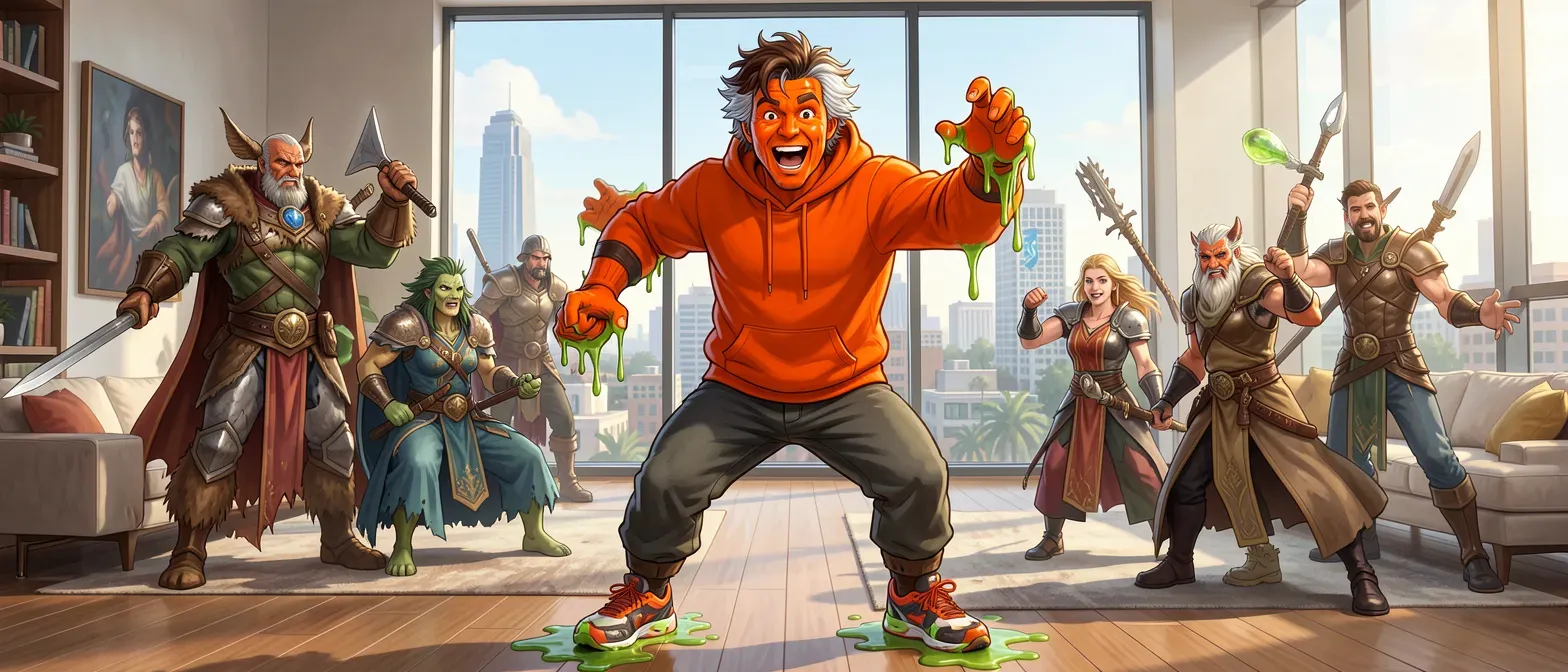
In the flickering glow of cathode-ray dreams, Nickelodeon 'Nick' Paramount was born in the crisp autumn of 1977, in a modest Ohio town where the air hummed with the promise of broadcast waves yet to crest. His mother, Qube, a sturdy woman with a voice like static on a summer night, cradled him close, while his father, Warner, a stern figure with eyes sharp as antenna spikes, paced the delivery room, already dreaming of distant horizons. They named him C3/Pinwheel at first, a whimsical nod to the spinning wheels of fate, but by 1979, as the world sharpened its edges, he shed that name like an old skin, emerging as Nickelodeon—Nick for short—a boy with wide, curious eyes and a mop of unruly brown hair that seemed to frizz with untapped energy.
Tragedy struck in 1984, raw and unrelenting, like a signal cut mid-transmission. Qube passed in the dead of winter, her final breath a whisper of unfinished stories, leaving Nick, just seven, huddled in the corner of their dim living room, tears carving rivers down his cheeks. Warner, unable to bear the silence, vanished into the night, abandoning his son to the echo of an empty house. Nick's cries pierced the quiet, a boy's howl against the indifferent sprawl of rural America. But fate, that capricious director, had scripts yet unwritten. Enter Viacom I, a burly man with a laugh like thunder and hands callused from twisting dials, and his wife, Paramount, elegant and poised, her gowns flowing like silver screens. They found Nick wandering the streets, a lost signal in the noise, and took him in—not through the cold bureaucracy of adoption, for in their world of channels and frequencies, family was forged in the ether, not ink. They reshaped him: his skin turned a vibrant orange, warm as sunset over Hollywood hills, infused with the slippery power of green slime that bubbled from his pores when emotions ran high. They whisked him to California, where palm shadows danced on stucco walls, and he became their own, blood or no.
MTV slunk in as his cousin, a wild-eyed youth with rhythms pulsing in his veins, always tapping feet to an invisible beat. In 1985, Nick's brother Nick at Nite arrived, a night owl with a penchant for vintage tales, his voice a gravelly drawl that lulled the dark hours. Three years on, in 1988, sister Nick Jr. toddled into being, tiny and bright, her laughter a tinkling melody that drew the youngest into her orbit. Nick, now a teenager navigating the sun-baked sprawl of LA, hungered for creation, for a legacy to drown out the ghosts of Ohio. By 1991, at fourteen, he dove into cartoons, sketching worlds of spongy seas and rebellious teens in a cluttered garage studio, his orange fingers smudged with ink and slime. The shows exploded—Rugrats, Doug, the wild antics of Ren & Stimpy—capturing hearts across the nation, his name synonymous with childhood wonder.
The family tree branched wildly: 1999 brought cousin Noggin, a thoughtful kid with a noggin full of knowledge, and the birth of SpongeBob, that absorbent yellow icon who became Nick's quirky sidekick, always ready with a jellyfishing net. Uncle CBS lumbered in, a patriarchal figure with a booming baritone and a wallet deep as prime-time slots. 2001 saw sister TeenNick bloom, all attitude and edge, her wardrobe a riot of neon and leather, while 2002 gifted brother Nicktoons, a hyperactive bundle of animation frenzy, sketching mid-sentence with a twitchy grin. Outside the family glow, friendships forged in 2004: Cartoon Network, the clever boy whose brain whirred like Dexter's lab, spouting equations with a Southern twang that twisted words into witty barbs; and Disney Channel, the enchanting girl wielding a magic wand that sparked illusions, her voice a lilting Southern belle accent that charmed secrets from the air.
Loss clawed back in 2005 when Viacom I faded, his chair empty at the dinner table. Paramount, resilient as celluloid, wed Viacom II, a sharper successor with CBS II's fraternal shadow—brothers in boardrooms, their merger a tangled web of alliances. 2009 brought reinventions: Nick's look sharpened, his orange hue more vivid, slime now a deliberate flair in his performances. The 2010s churned with corporate tides—2019's fusion of Viacom II and CBS II into ViacomCBS, a hulking entity that swallowed identities whole, rebranded to Paramount Global in 2022 amid boardroom battles that left Nick's slime-slick hands trembling. 2024 stole Noggin, a quiet passing that echoed Qube's, leaving a void in the knowledge streams. Yet forward marched 2025, Paramount entwining with Skydance in a dazzling merger, birthing Paramount Skydance, a phoenix of streaming skies.
Now, at 47, Nick stands tall in a sleek LA penthouse overlooking the Pacific, his orange skin glowing under LED lights, dressed in a casual orange hoodie emblazoned with his logo, jeans faded from years of set runs, and sneakers perpetually gooey from slime spills. His hair, streaked with silver, still frizzes wildly, and he speaks with an enthusiastic Midwestern lilt softened by Cali sun, words tumbling like cartoon bubbles. He wants nothing more than to etch his saga into eternity, to shield his fractured family from obsolescence's maw. But the industry devours the young, algorithms feast on the forgotten, and corporate fusions twist kin into strangers—why else did Warner flee, why did Noggin dim? Nick fights back with relentless innovation: new shows, viral slimes, alliances that bridge rival networks. It works because his heart, slimy and true, resonates—kids crave his chaos, adults his nostalgia. Conflicts rage: sibling rivalries flare like static, uncles hoard power, friends drift in competitive winds. Yet in quiet nights, Nick gazes at old reels, embracing the abandonments and rebirths as his destined script, a hero's odyssey in orange hues, unyielding against the fade to black.