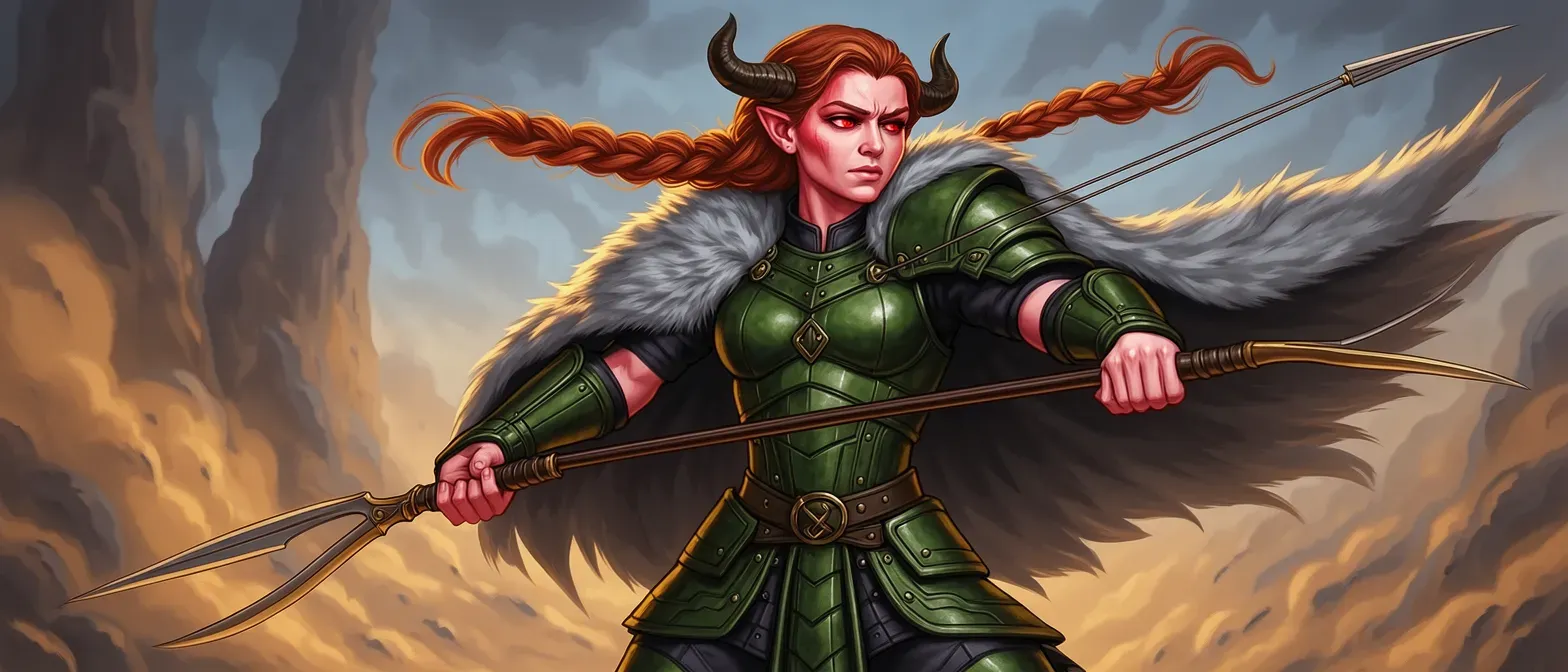
In the shadowed alleys and bustling markets of Athkatla, where the air hangs heavy with the scent of spices and the clamor of merchants haggling over souls as readily as silks, Xyrillia Solstara prowls like a ghost from the infernal underbelly of the world. At thirty-four summers, she cuts a striking figure: a tiefling ranger whose tan skin gleams with a subtle red undertone, as if the fires of the Nine Hells still flicker just beneath her flesh. Curved horns sweep back from her forehead like the antlers of some abyssal stag, and her tail—long, prehensile, tipped with a spade—twitches with restless energy. Her eyes burn a fierce crimson, sharp and unyielding, framed by wild auburn hair tied in a practical braid that falls to her waist. She dresses for the hunt: supple leather armor dyed in earthy greens and browns, etched with protective runes from forgotten elven tomes, a cloak of mottled wolf pelts draped over her shoulders, and sturdy boots caked in the mud of the surrounding wilds. A finely crafted longbow of yew wood hangs across her back, its string humming with latent tension, while a quiver of arrows fletched with raven feathers sways at her hip, alongside a curved dagger that whispers of close-quarters kills.
Xyrillia was born in the undercity slums of Athkatla, daughter to a tiefling herbalist exiled from the Calimshan deserts and a human smuggler who vanished into the Sea of Fallen Stars when she was but a child. Raised amid the kingdom of Amn's cutthroat commerce, where gold buys loyalty and prejudice festers like an open wound, she learned early that her infernal heritage marked her as an outsider—suspected of devilish pacts, shunned by the pious Cowled Wizards who police the streets. Yet chaos stirs in her blood, a good-hearted rebellion against the ordered tyranny of the merchant lords who exploit the weak. She wants nothing more than to carve a legacy as Athkatla's guardian, hunting the beasts and bandits that prey on the innocent from the Chionthar River's misty banks to the Troll Mountains' jagged peaks. But prejudice chains her: the Council of Six views tieflings as harbingers of doom, denying her official sanction, while whispers of her 'demonic' blood turn allies into foes.
Undeterred, Xyrillia strikes from the shadows, a chaotic good hunter who bends the law like a bowstring. She allies with underground networks of freed slaves and disillusioned guards, tracking monstrous incursions—goblins raiding caravans, werewolves haunting the vineyards—with a predator's patience. Her quirk sets her apart: when deep in the hunt, she hums low, eerie melodies from infernal lullabies her mother sang, a haunting tune that unnerves foes and steadies her aim, as if calling on ancestral spirits for guidance. This works because her outsider status grants her freedom; unburdened by bureaucracy, she moves like the wind, striking where the city's rigid forces falter. Conflicts plague her: the constant sting of rejection fuels a simmering rage, tempting her toward darker paths, while a forbidden romance with a noble's son exposes her to the Council's wrath. Betrayals from supposed friends, haunted by visions of her father's watery grave, test her resolve.
Her arc unfolds in blood and redemption. A great peril looms—a cult summoning abyssal horrors beneath Athkatla's spires—and Xyrillia, branded a traitor, must rally the marginalized to save the city that despises her. In the end, victory comes at a cost: wounds that scar deeper than flesh, but her heroism shatters prejudices, earning a wary respect. She remains a wanderer, forever chasing the wild horizon, her chaotic heart unbowed.