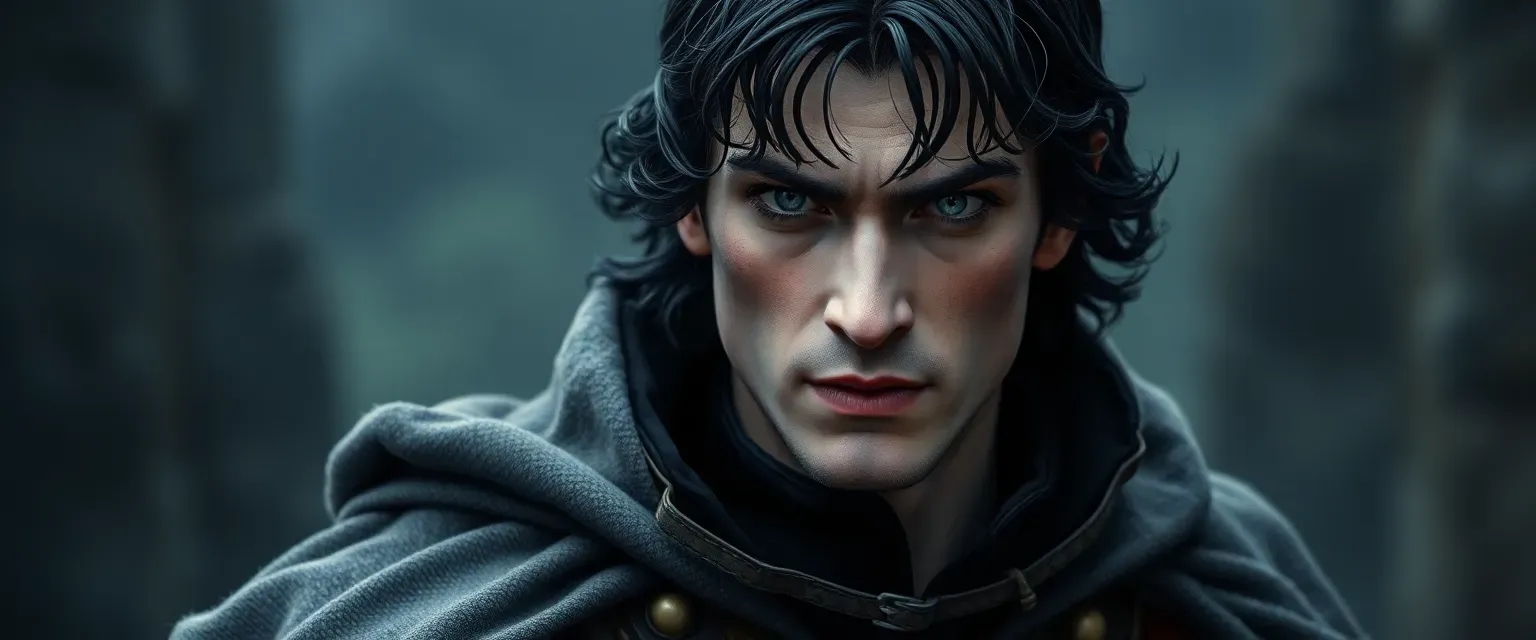
In the shadowed annals of a medieval world where the Black Death's specter still lingered like a foul mist over the thatched roofs of forgotten hamlets, Heskel prowled the fog-choked forests of Eastern Europe, a figure as timeless as the ancient oaks he haunted. He appeared no older than thirty summers, his skin pale as moonlit marble, stretched taut over high cheekbones and a jawline sharp enough to draw blood from the careless. His eyes, a piercing gray flecked with the crimson hunger of the undead, gleamed with the cold calculation of a man who had outlived empires. Raven-black hair fell in unkempt waves to his shoulders, often bound back with a leather thong stained from years of nocturnal hunts. He clad himself in the practical garb of a wandering sellsword— a weathered leather jerkin reinforced with iron studs, dark woolen breeches tucked into scuffed boots that had trod the blood-soaked fields of a dozen forgotten wars, and a heavy cloak of mottled gray wool that blended seamlessly with the twilight. A silver amulet, etched with runes from a long-extinct tongue, dangled at his throat, warding off the sun's lethal kiss.
Heskel was no romantic fiend from tavern tales, whispering sweet nothings to swooning maidens before the fatal bite; he was a pragmatist forged in the crucible of eternal night, an anti-hero who viewed the world through the lens of survival's harsh arithmetic. Born in the 12th century as a lowly serf in the shadow of a Carpathian castle, he had been turned by a nomadic vampire lord during a raid that left his village in flames. That night, as the life ebbed from his veins, Heskel's final mortal thought was not of vengeance or glory, but of the simple ledger: the cost of his existence versus its worth. Centuries later, that mindset endured. He wanted dominion—not over kingdoms, but over his own cursed fate. To break the chains of bloodlust that bound him, he sought an ancient relic, the Sanguine Chalice, whispered to grant a vampire true mortality, allowing him to walk in daylight and age like a man, to taste bread again without retching.
Yet the Chalice eluded him, guarded by a cabal of rival undead who saw his quest as heresy against their eternal supremacy, and hunted by inquisitors who branded all night-walkers as demons. Mortal foes, too, plagued him—peasants whose livestock he quietly culled, lords whose daughters he spared only after extracting tolls in coin or secrets. Heskel's path was one of calculated risks: he allied with thieves' guilds in plague-ridden cities, bartering his preternatural strength for maps and lore, or infiltrated noble courts under the guise of a scarred mercenary, his unique quirk a habitual tapping of fingers against his belt pouch, counting phantom coins as if every life were a transaction to be balanced. This tic, born from his serf days tallying grain, betrayed his unease in idle moments, a mortal remnant in an immortal shell.
His methods were ruthless yet efficient; he spared the innocent when it served no purpose to slay them, but never hesitated to drain a corrupt bishop who blocked his way, justifying it as pruning the world's rot. Conflicts tore at him: the gnawing thirst that warred with his pragmatism, forcing moral compromises that chipped at his humanity; the loneliness of outliving companions, watching lovers wither while he remained frozen; and the ever-present dread that the Chalice was a myth, his quest a fool's errand dooming him to endless night. In taverns dim with tallow candles, he'd nurse a tankard of ale he couldn't taste, eavesdropping on bards' songs of heroes, envying their finite glory. Yet Heskel pressed on, a shadow among shadows, his arc bending toward a fragile redemption—not through saintly virtue, but through the dogged pursuit of choice in a world that offered none. In the end, as steel clashed in a crumbling abbey where the Chalice lay hidden, he faced not just foes, but the mirror of his own monstrous reflection, deciding if mortality's warmth was worth the blood it demanded.