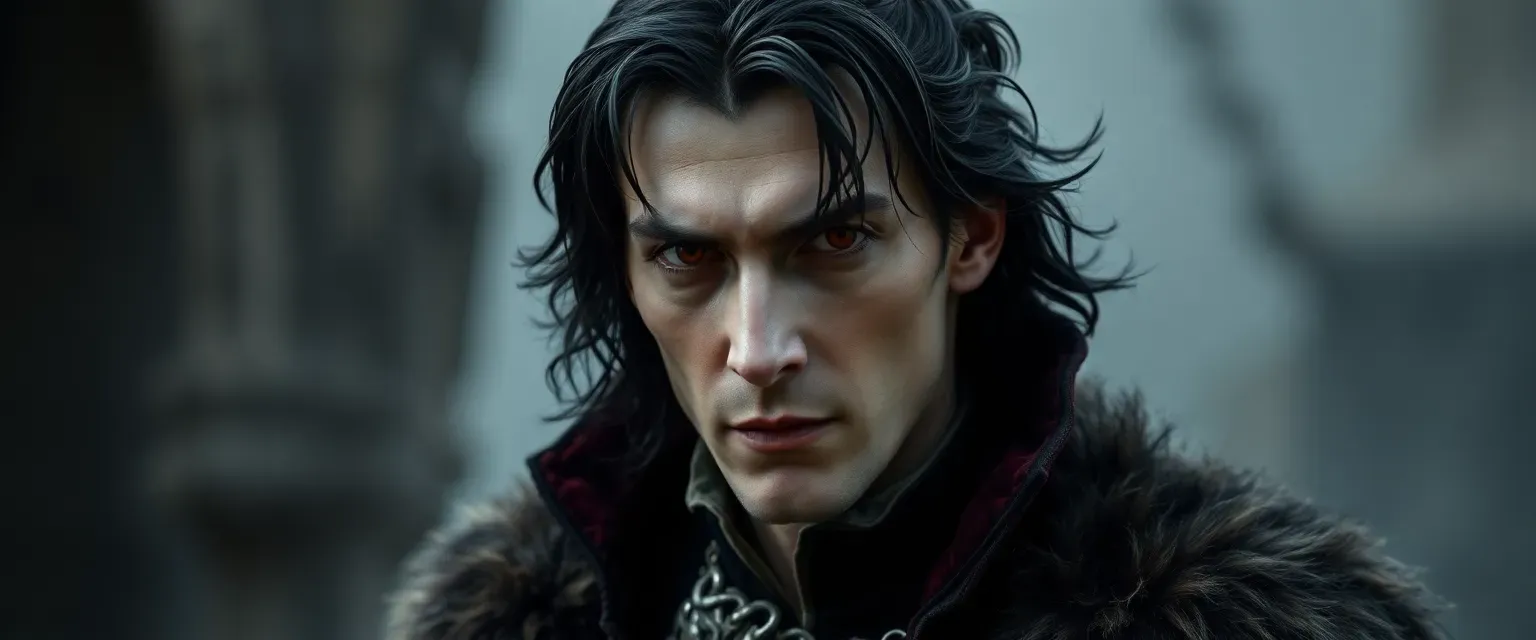
Heskel was born in the shadowed eaves of 12th-century Wallachia, a land of mist-shrouded Carpathian peaks and Orthodox spires piercing the eternal dusk. Once a scholar-priest named Heskel the Pious, he delved too deeply into forbidden tomes smuggled from Constantinople, seeking the alchemical elixir that would grant dominion over death itself. But the blood curse found him first—a nocturnal assault by an elder vampire in the crypts of a forgotten monastery. Now, eight centuries later, he endures as an undead lord, his flesh preserved in pallid perfection, appearing as a man in his prime thirties: tall and gaunt, with skin like polished marble veined in faint blue, eyes burning with the crimson hunger of fresh-spilled wine, and raven hair falling in unkempt waves to shoulders clad in a threadbare velvet doublet of faded burgundy, embroidered with silver sigils of long-extinct heraldry. A heavy cloak of wolf-pelt, stained by the rains of countless eras, drapes his frame, and at his belt hangs a silver chalice, etched with blasphemous runes, ever ready for his sanguine feasts.
Heskel craves the throne of eternal night, to subjugate the mortal realms under vampiric rule, weaving a web of shadowed alliances from the courts of kings to the hovels of serfs. His genius lies in the intricate tapestries of deceit he spins—poisoned whispers that topple dynasties, alchemical rites that bind thralls to his will. Yet the sun's merciless gaze bars his ascent, as does the relentless pursuit of the Order of the Silver Dawn, holy warriors armed with stakes and sanctified blades, who hunt his kind with fanatic zeal. The curse's insatiable thirst gnaws at him too, clouding his mind with feral urges that threaten to unravel his meticulously laid schemes.
To counter these foes, Heskel prowls the medieval labyrinths of stone-walled cities and fog-choked forests, seducing nobles with promises of immortality, turning trusted knights into his ghoulish vanguard, and unleashing plagues laced with his venom to weaken the faithful. His methods succeed through sheer intellect—a chessmaster's foresight, anticipating betrayals seasons in advance, his twisted scripture recitations lulling victims into false piety before the bite. Conflicts rage within: the echo of his mortal faith wars with vampiric amorality, birthing a quirk where he intones prayers in a sibilant, archaic Romanian lilt, fangs lisping over Latin syllables, mocking the divine even as he devours. Betrayals from fledglings he sires, and the inexorable decay of his mortal ties, fuel his isolation. In the end, Heskel's empire crumbles under a solar eclipse's betrayal, staked by a descendant of his own turned kin, his chalice shattering as the dawn reclaims what night stole—yet in unlife's cycle, his essence lingers, scheming resurrection from the grave's embrace.