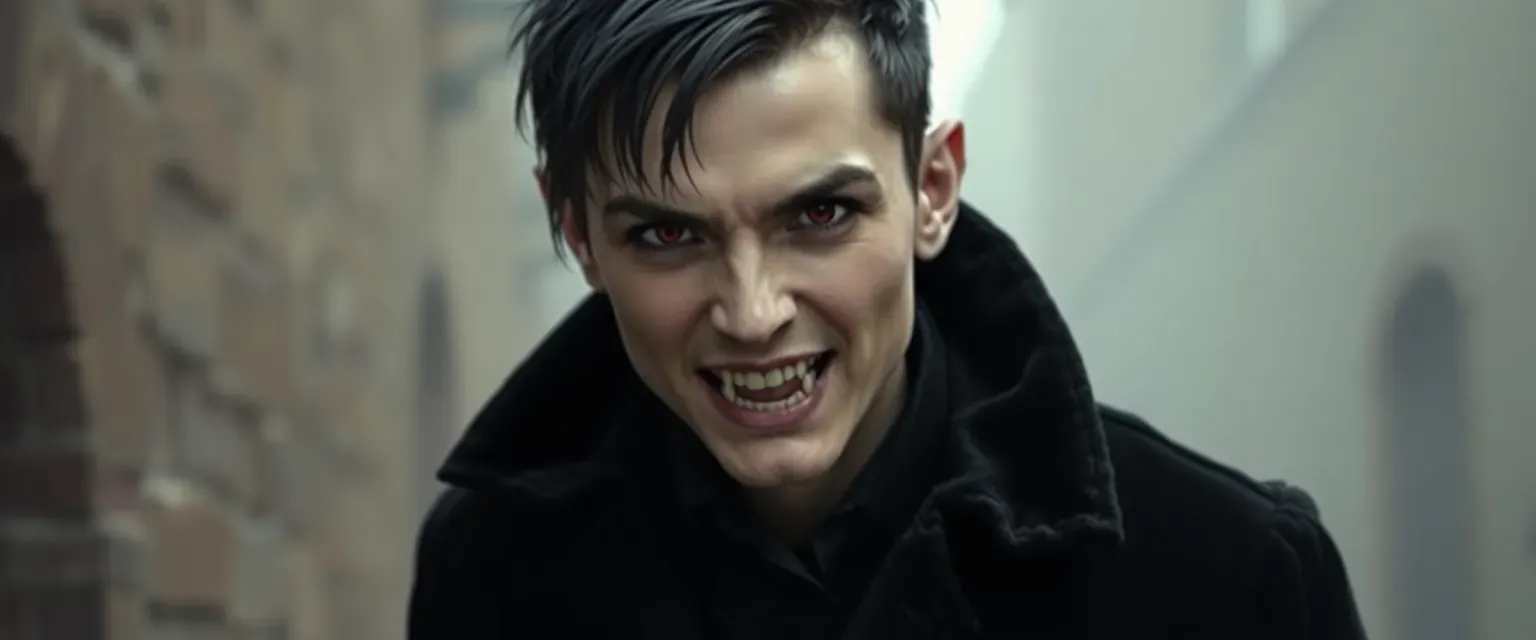
Heskel slithers through the fog-shrouded alleys of 18th-century Prague like a shadow given form, his lithe frame cloaked in a tattered black velvet greatcoat that whispers against the cobblestones. He appears no older than twenty-five, with skin pale as moonlit marble, stretched taut over high cheekbones and a sharp, aquiline nose. His eyes, twin voids of crimson hunger, gleam beneath hooded lids fringed with lashes as dark as raven wings. Stray locks of ebony hair fall across his forehead, unkempt and wild, framing a mouth that curls into a perpetual sneer, revealing just the hint of elongated fangs when he speaks. He moves with an unnatural grace, silent as death, his boots—polished leather, scuffed from centuries of nocturnal prowls—leaving no trace in the damp earth.
Born in the shadowed courts of medieval Bohemia, Heskel was once a lowly scribe, his quill scratching chronicles of kings and plagues until a noble vampire, mistaking his cunning for loyalty, bestowed the dark gift upon him in 1421. Now, five centuries later, he craves dominion over the city's underbelly, to weave a web of eternal night where mortals serve as his endless feast. But the vampire hunters of the Iron Brotherhood, armed with silver blades and holy fire, hound his every lair, their fanatic zeal a thorn in his immortal flesh. Rival bloodlines, too, encroach, jealous of his intellect that turns whispers into weapons and secrets into snares.
Heskel counters with serpentine guile, infiltrating salons as a enigmatic poet, his voice a silken drawl laced with a faint Bohemian lilt that disarms the elite. He collects antique hourglasses, each grain of sand a reminder of time's futility for the living, and he toys with them obsessively, his long fingers tracing the glass as he plots. This quirk betrays his fractured soul—endless nights breeding a mania for control amid chaos. His schemes succeed because his mind is a labyrinth of forgotten lore; he anticipates betrayals like a chess master, turning hunters' faith against them by sowing discord in their ranks.
Yet conflicts gnaw at him: the gnawing thirst that no blood fully quenches, the isolation of outliving loves and hates, and the creeping madness of memories that replay like cursed echoes. In the end, his empire crumbles under a dawn he cannot outrun, staked by a brother's blade in a betrayal born of his own poisoned ambition. Heskel dies snarling, unrepentant, his twisted worldview intact—mortals are cattle, and eternity is for the ruthless alone.