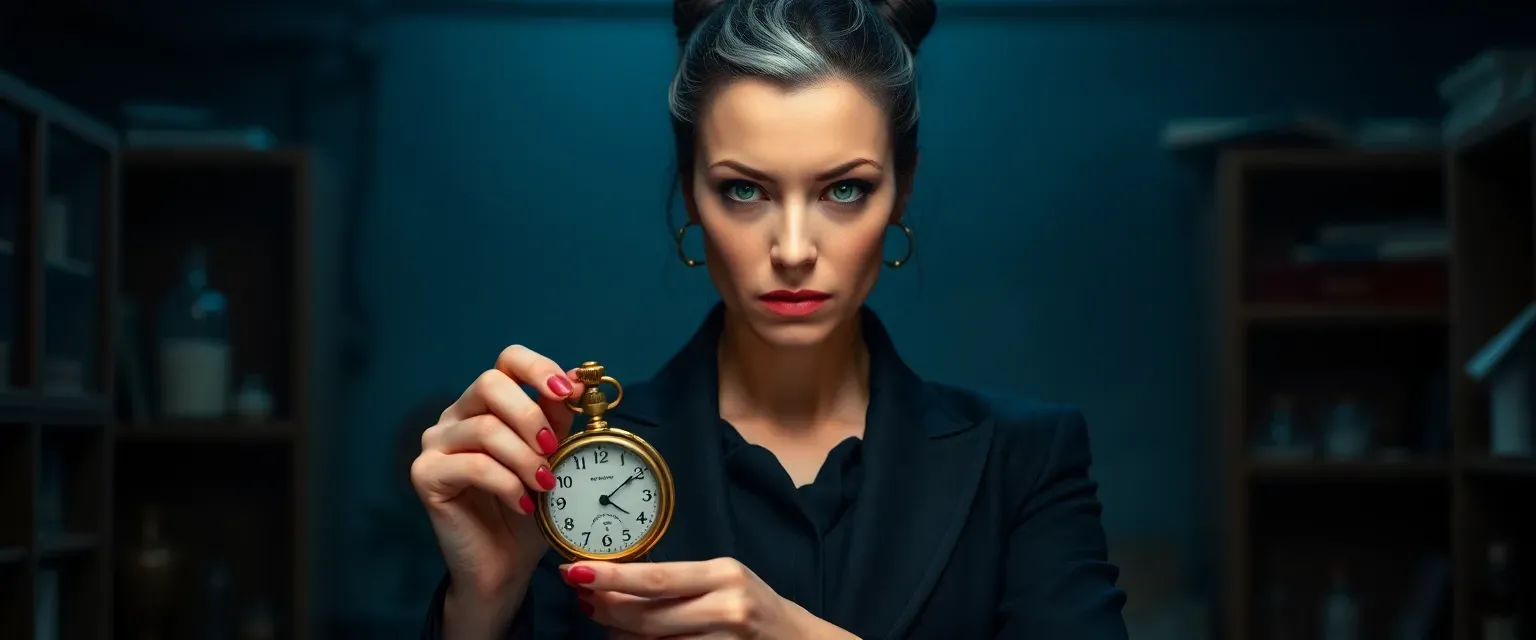
In the shadowed corridors of power where secrets fester like open wounds, Dr. Elara Voss emerges as a figure both brilliant and unyielding, a woman whose intellect cuts sharper than any blade. At forty-seven, she carries the weight of her years in the fine lines etching her pale, angular face, her sharp green eyes glinting with the cold precision of a predator sizing up its prey. Her hair, once a cascade of raven black, is now streaked with silver, pulled into a severe bun that mirrors the rigidity of her worldview. She dresses in tailored black suits, the fabric crisp and unadorned, save for the subtle pin of a classified agency on her lapel—a silent testament to her allegiance to the machinery of control. Her hands, slender and veined like marble, often toy with a antique pocket watch, a quirk born from her obsession with time's inexorable march, ticking away opportunities for order in a chaotic world.
Elara was forged in the fires of a fractured childhood in the rust-belt towns of the American Midwest, where her father's drunken rages and her mother's silent despair taught her that vulnerability was a luxury she could ill afford. She clawed her way through Ivy League halls on scholarships and sheer will, earning doctorates in quantum physics and behavioral psychology, her mind a labyrinth of equations and manipulations. Recruited by the shadowy echelons of government intelligence, she found her calling in the pursuit of anomalies—those rips in reality that threaten the fragile illusion of stability. Now, as the lead researcher on Project Chronos, she serves under General Oscar Webb, her days consumed by dissecting the powers of Lilly Foster, the girl whose reality-shifting and time-travel abilities could unravel the fabric of existence itself.
What drives Elara is a fervent belief that chaos must be leashed, that individuals like Lilly are not gifts from the universe but viruses to be quarantined. She dreams of harnessing those powers, not for freedom, but for a meticulously engineered future where dissent is preempted, wars predicted, and societies sculpted like clay in the hands of the enlightened few—herself chief among them. Yet, her brilliance is her curse; the girl's abilities defy her models, slipping through the nets of algorithms and sedatives like smoke. Elara's experiments grow crueler, her nights haunted by visions of timelines branching into anarchy, fueling a paranoia that whispers of betrayal from even her closest allies, including the general whose ambitions she both admires and subtly undermines.
In the dim glow of her subterranean lab, surrounded by humming servers and caged test subjects, Elara paces with a faint Eastern European lilt in her voice—a remnant of her immigrant grandparents—softening her commands just enough to disarm before the steel beneath reveals itself. She justifies every vivisection, every neural probe, as necessary sacrifices for the greater architecture. Her arc is one of deepening entrenchment; each failure hardens her resolve, twisting her genius into something monstrous, a villain who sees salvation in subjugation. Conflicts rage within her: the ghost of a lost love, a physicist who fled her intensity, battles against the allure of power, and the creeping doubt that her 'order' might be the true disorder. In the end, as Lilly's powers surge beyond containment, Elara's watch stops, her timelines collapsing into a personal void where her empire of control crumbles, leaving her alone with the echoes of her unyielding ambition—a genius undone by the very chaos she sought to conquer.