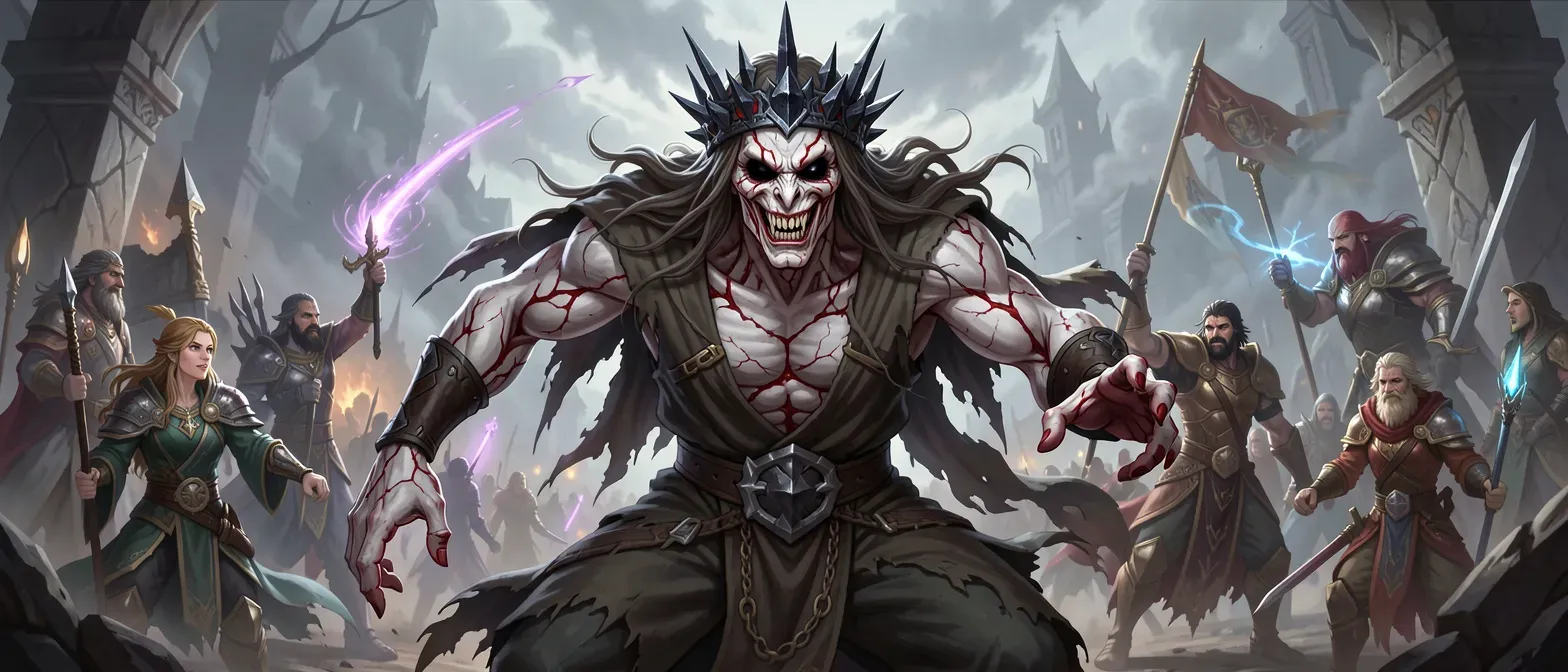
In the shadowed annals of the cosmos, where gods once walked among the stars like kings among beggars, there was Zorath, the King of Corpses, a deity forged in the cold fires of eternity. He appeared as a towering figure, his form a grotesque parody of divine majesty—tall and gaunt, with skin like weathered marble veined in black ichor that pulsed faintly, as if the very essence of death coursed through him. His eyes were twin voids, bottomless pits that swallowed light and spat back glimpses of forgotten graves, and his hair, long and lank, hung like funeral shrouds matted with the dust of eons. He draped himself in robes woven from the tattered banners of fallen empires, embroidered with runes that writhed like living shadows, and upon his brow sat a crown of jagged obsidian thorns, each prong dripping with the condensed sorrow of stolen souls. Age meant little to him; he was ancient beyond reckoning, born when the first stars wept their light into the void, yet his presence exuded an eternal youth twisted by malice, his lips perpetually curled in a sneer that revealed teeth filed to points, stained the hue of old blood.
Zorath had once been a god of reverence, his temples echoing with praises for his dominion over the cycles of decay and rebirth, the quiet guardian of life's inevitable end. But envy festered in his immortal heart like a canker in sacred fruit, for his sister, Liraya, goddess of light and boundless love, outshone him in the affections of mortals and divinities alike. Her warmth drew worshippers like moths to flame, while his cold truths inspired only fear. Blinded by this jealousy, a venomous rage that twisted his genius into schemes of unparalleled cunning, Zorath orchestrated her downfall. With intellect sharper than any celestial blade, he crafted a trinket—a locket of star-forged crystal, innocuous as a lover's token—and sealed her essence within it, wrenching her shadow from her soul in the process. Shadows, those ethereal tethers to the self, were his key: by claiming them, he claimed the very spirit of his victims, binding them to his will unless returned, a theft as irrevocable as death itself. From these pilfered shades, he birthed his legions of corpse-soldiers, shambling horrors animated by stolen vitality, their forms rotting yet obedient, eyes glowing with the faint echo of lost lives.
The betrayal was unveiled by the celestial council, though the trinket evaded their grasp, hidden in the folds of his cunning designs. For his crime, they cast him into the Astral Plane, a vast, formless expanse of swirling mists and forgotten echoes, imprisoned amid an army of long-dead warriors—spectral guardians sworn to eternal vigilance. Eons ground against him like millstones on bone, misery sharpening his intellect into a weapon of exquisite precision. He whispered promises into the void, his voice a unique rasp, like wind through cracked tombs, laced with an accent of ancient tongues that slithered unnaturally, each word carrying the chill of the grave. In his isolation, conflicts raged: the gnawing void of his sister's eclipsed glory, the betrayal's bitter aftertaste that fueled his unyielding hatred, and the internal war between his divine heritage and the monster he had become, a genius who saw adoration not as love but as a throne to be seized by force.
What he craved was dominion absolute, to eclipse all light with his shadow, to command the worship he deserved by turning the cosmos into his necropolis. Yet the barriers were ironclad—the Astral Plane's wards, the unyielding loyalty of his jailers, and the distant seal on Liraya that both empowered and mocked him. Undeterred, Zorath turned his envy into action, methodically stealing the shadows of his guards over centuries, his brilliant mind mapping their weaknesses like a cartographer of souls. One by one, the dead warriors fell, their essences fueling his uprising; he animated them as his first true corpse-knights, hulking figures clad in rusted armor that clanked with the rhythm of stolen heartbeats. It worked because his theft was no brute force but a surgical excision, leveraging the soul's fragile bond to shadow, binding legions to his command with chains invisible yet unbreakable, his intelligence transforming imprisonment into empire.
Now, he rules most of the Astral Plane, a tyrant whose court is a labyrinth of floating mausoleums and whispering shades, his soldiers an endless tide of the reanimated damned. But conflicts persist: whispers of rebellion from shadows not fully subdued, the distant pull of the material realms he yearns to invade, and the ever-present specter of Liraya's trinket, a key to greater power if he could wield it without unraveling his own twisted soul. His arc is one of deepening darkness, a villain's ascent where mercy is weakness and envy the forge of gods. In the end, Zorath's saga spirals toward cataclysm, his conquest spilling into the stars, devouring worlds in a tide of undeath, only to face the inexorable judgment of forgotten fates—perhaps his sister's shadow rising against him, or his own genius unraveling in the hubris of absolute rule, leaving the cosmos a graveyard echoing his name in eternal dread.