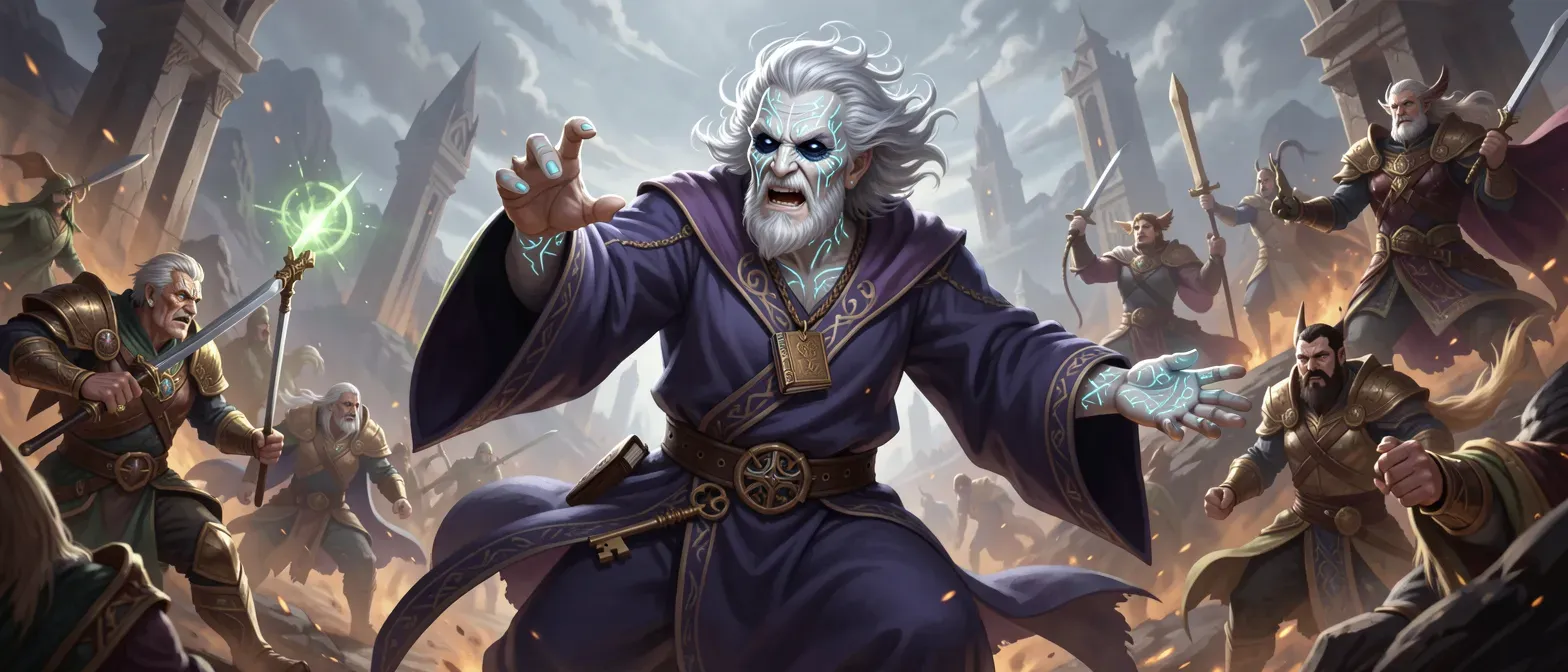
In the shadowed annals of the eternal cosmos, where stars whisper secrets to the void, there dwells Abed, the God of Wisdom, an ancient being whose form defies the frail boundaries of mortality. He appears as a man in the twilight of his years, perhaps seventy cycles of the sun, though time bends around him like smoke. His skin is parchment-pale, etched with faint, glowing runes that pulse like veins of liquid starlight, mapping the accumulated knowledge of eons. Eyes like polished obsidian, deep and unblinking, pierce through illusions, revealing the hidden truths that lesser souls dare not face. A mane of silver hair cascades to his shoulders, unkempt and wild, as if winds from forgotten libraries tousle it eternally. He wears robes of deepest indigo, woven from threads of forgotten scrolls and bound with a belt of interlocking bronze keys—each one unlocking a door to some arcane mystery. Around his neck hangs a pendant shaped like an open book, its pages eternally turning in an unseen breeze.
Abed wanders the fractured realms of gods and men, a solitary pilgrim driven by an insatiable hunger to illuminate the darkness of ignorance that plagues creation. He yearns to forge a world where wisdom flows as freely as rivers, binding mortals and immortals in harmonious understanding, banishing the chaos of folly that births wars and woes. Yet, this noble pursuit eludes him, thwarted by the very essence of free will he cherishes; mortals, in their stubborn pride, twist his gifts into weapons of deceit, scholars hoard knowledge like dragons their gold, and even fellow deities mock his earnestness as meddlesome folly. The weight of misunderstood truths has woven isolation into his divine tapestry, a loneliness that echoes through the halls of his mind like unanswered echoes.
Undeterred, Abed descends into the mortal coil, cloaked in guises of sage or wanderer, dispensing counsel through enigmatic parables and riddles that demand the seeker confront their own shadows. He convenes secret conclaves in mist-shrouded groves, debates with philosophers under blood moons, and inscribes forbidden tomes in hidden scriptoria, each act a calculated ripple to erode the barriers of ignorance. His methods succeed because his intellect is a forge of unparalleled acuity—dissecting complexities with surgical precision, anticipating deceptions layers deep, turning adversaries' arrogance against them in webs of inevitable revelation. He possesses a unique quirk: a soft, resonant voice that carries an otherworldly echo, as if every word reverberates from the birth of the universe itself, compelling listeners to lean closer, ensnared by the gravity of his timbre.
Yet, conflicts beset him like thorns in a crown. Internally, he grapples with the hubris of omniscience, questioning if true wisdom lies in sharing or withholding, his divine detachment clashing with a burgeoning empathy for mortal frailty. Externally, rival gods of war and passion scheme to undermine him, fearing enlightenment would dull their savage games, while mortal kings brand him a heretic for truths that shatter empires. In the end, Abed's odyssey culminates in a cataclysmic convergence: a grand council where he unveils the ultimate codex, forcing all to reckon with unvarnished reality. Some ascend to enlightenment, others shatter in denial, but Abed emerges transformed, his isolation fractured by fragile alliances, wisdom no longer a solitary flame but a shared constellation, illuminating paths unforeseen even by a god.