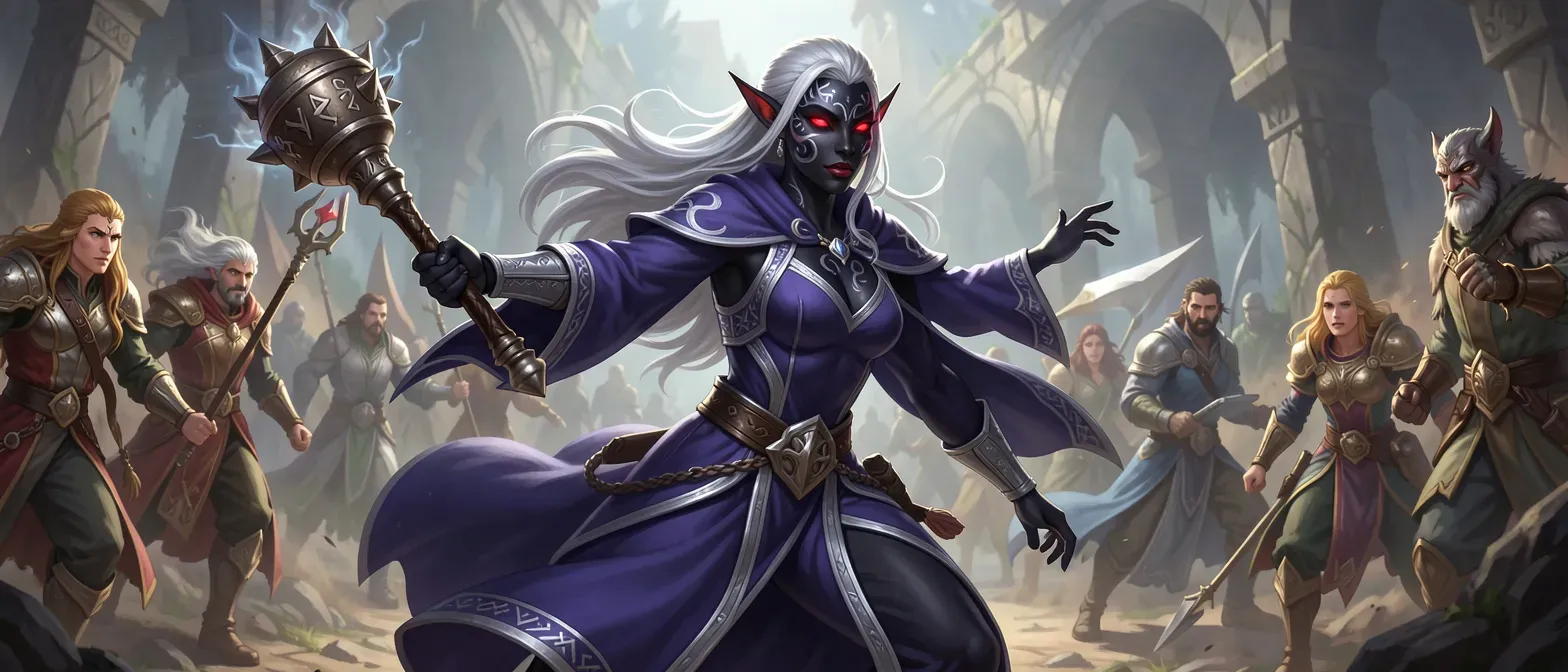
In the shadowed depths of the Underdark, where the eternal night clings like a shroud woven from spider silk, Cressida was born into the treacherous web of drow society, a female elf of the deep with skin as black as polished obsidian and hair like threads of silver moonlight that cascaded down her back in defiant waves. At twenty-eight years—an age still young among her kind, yet marked by the scars of survival—she stood tall and lithe, her frame honed by years of evasion and quiet rebellion. Her eyes, crimson orbs that gleamed with an inner luminescence, betrayed the fervor of her faith, while faint, intricate tattoos of interlocking crescents traced her high cheekbones and slender neck, symbols of the Twilight Domain she served. She draped herself in robes of deep indigo, edged with subtle silver embroidery that evoked the hazy border between day and night, a mace of blackened iron hanging at her belt, its head etched with runes that whispered of protective vigils. A simple amulet of twilight's eclipse dangled from her throat, pulsing faintly in the gloom.
Cressida had once been a priestess in the making for Lolth, the Spider Queen, her life scripted by the cruel matriarchy of Menzoberranzan, where betrayal was breath and ambition a blade. But a vision in the fungal caverns—a fleeting glimpse of balance, where light pierced the endless dark without consuming it—shattered her devotion. She turned to the Twilight Goddess, seeking a world where neither endless night nor blinding day held sway, where the weary found sanctuary in the dim hours. What she craved was to forge a haven in the Underdark, a sanctuary city where outcasts like herself could thrive under twilight's gentle rule, free from Lolth's venomous whims.
Yet the drow houses, with their priestesses' scrying eyes and assassins' daggers, hunted her as a heretic, branding her visions as madness. Her own kin saw her mercy as weakness, her faith a betrayal that invited surface-world taint. Isolation gnawed at her; allies were scarce, for who trusted a drow cleric preaching equilibrium in a realm built on dominance? Whispers of doubt plagued her nights— was this path folly, or the only light in her darkness?
Undeterred, Cressida wandered the labyrinthine tunnels, her unique quirk a soft, rhythmic humming of ancient twilight hymns that echoed like distant thunder, a sound that calmed the feral beasts of the deep and steadied her own trembling resolve. She gathered misfits: goblin refugees, duergar dissidents, even a few disillusioned drow, weaving them into a covert network. With her clerical magic, she conjured zones of twilight that veiled their camps, shielding them from patrols and fostering fragile trust. Her spells mended wounds and minds, drawing the broken to her cause, for in her presence, the oppressive dark felt less suffocating.
This worked because Cressida's intelligence lay not in brute conquest but in subtle manipulation of shadows and light, turning the Underdark's own perils against her foes—illusions of encroaching dawn to scatter Lolth's zealots, or enveloping dusk to conceal escapes. Her arc bent toward quiet defiance, each convert a step from outcast to beacon, though conflicts raged: internal torment over her sisters' executions ordered in her name, raids that claimed innocents, and the ever-looming threat of recapture, where Lolth's curses might twist her gifts into curses.
In the end, her sanctuary rose in a forgotten cavern, a fragile twilight realm that endured, not through victory, but survival—a testament to her unyielding vision, even as larger wars loomed to test its fragile peace. Cressida, ever the guardian, hummed on into the gloom, her crimson eyes fixed on the horizon between worlds.