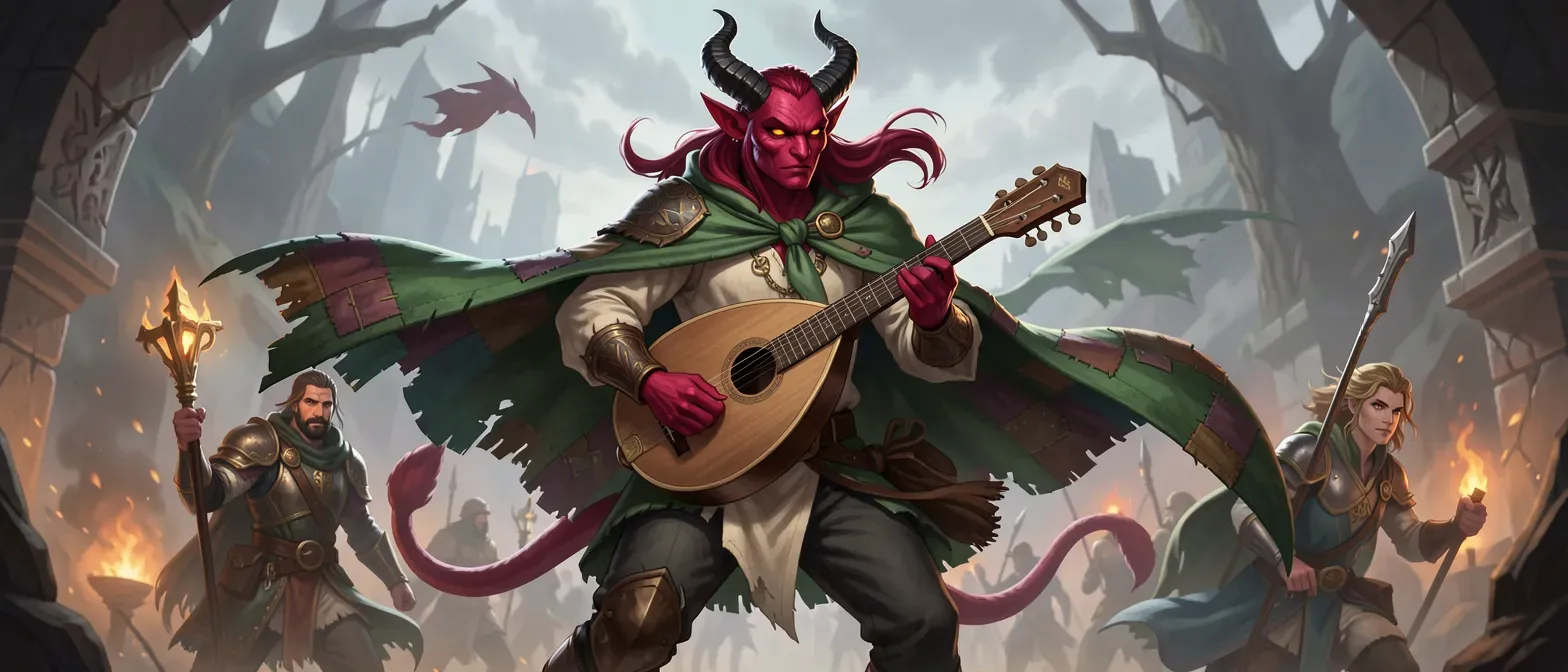
Lazier was a tiefling bard whose infernal heritage marked him from birth—curved obsidian horns curling back from his forehead, skin the deep crimson of smoldering embers, and a sinuous tail that flicked with unspoken emotions. At twenty-eight summers, he carried the lean, wiry build of one who'd spent years wandering dusty roads, his amber eyes shadowed by memories that clung like smoke. He dressed in the faded finery of a traveling minstrel: a patchwork cloak of emerald and gold, threadbare at the hems, over a simple linen tunic and breeches tucked into scuffed leather boots. Around his neck hung a silver locket, etched with runes from a life long shattered, and his constant companion was a well-worn lute strung with gut from beasts he'd never name.
Born in the shadowed alleys of a forsaken port town, Lazier grew up amid whispers of devil's spawn, his tiefling blood a curse that drew stones and scorn. But it was the night the cult came—worshippers of forgotten abyssal lords—who razed his home, claiming his family as sacrifices to fuel their dark rites. He alone escaped, haunted by the screams that echoed in his dreams, the guilt of survival twisting like a knife. Neutral good to his core, he sought not vengeance but solace, pouring his pain into melodies that wove tales of lost innocence and quiet heroism.
What Lazier craved was redemption, a way to silence the ghosts that plagued him and prove his worth beyond his bloodline. Prejudice barred him—townsfolk crossed streets at his approach, bards' guilds shut their doors—yet he persisted, strumming haunting tunes in taverns and crossroads, using his voice to rally the downtrodden against petty tyrants and unseen evils. His unique quirk was a soft, lilting whistle that escaped unbidden when deep in thought, a remnant of childhood songs now laced with melancholy, drawing listeners despite their wariness.
His arc unfolded on endless trails: aiding villagers with clever songs that exposed corruption, forging bonds with outcasts who saw past his horns. It worked because his infernal charm, amplified by bardic magic, pierced hearts, turning fear to empathy. Conflicts raged—inner demons urging isolation, outer foes exploiting his heritage—yet through it all, he found fragments of peace, his journey culminating not in grand triumph but a quiet acceptance, lute in hand, composing anthems for the haunted souls like his own.