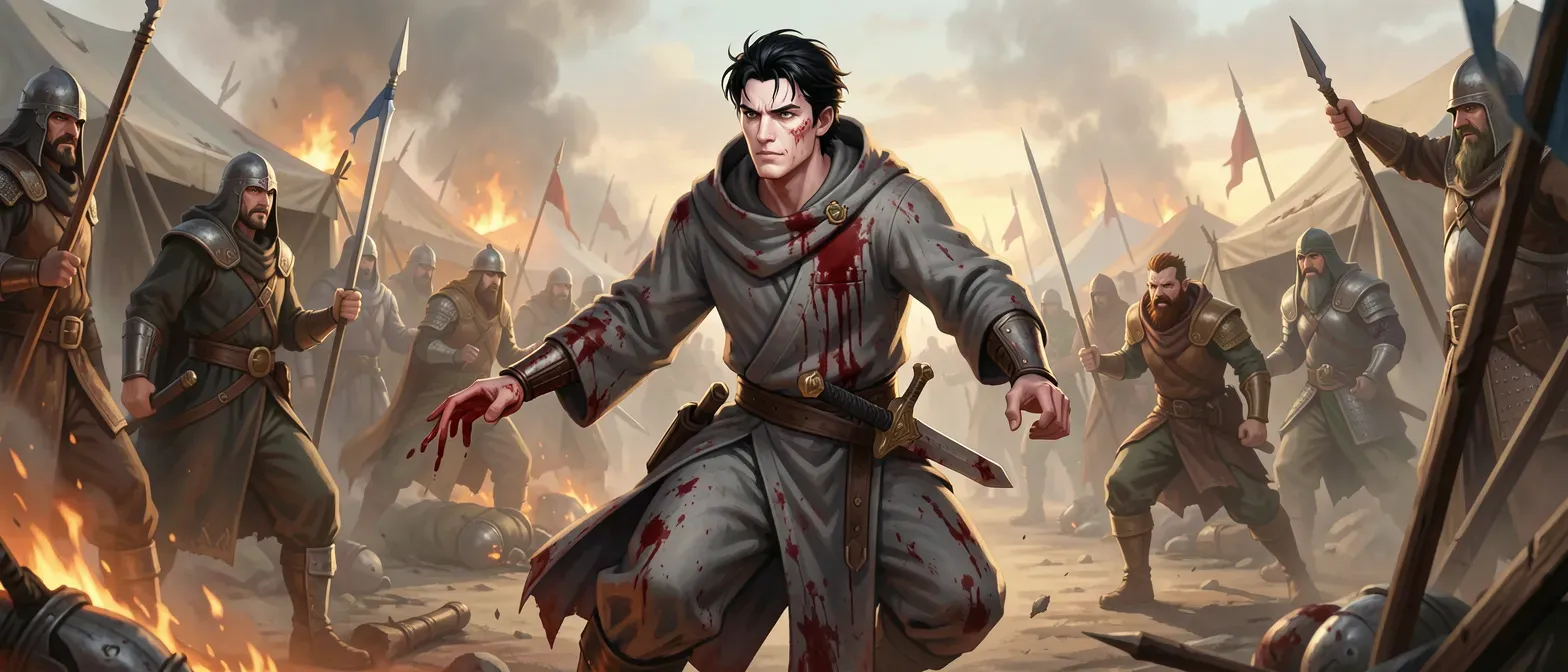
Draven was a shadow among the flickering torchlights of Warrior's Rest, a forsaken sprawl of mud-churned tents and blood-soaked pallets on the fringes of Kaon's blighted empire. At twenty-five, he cut a figure both unassuming and unnerving: tall and lean, his frame corded with the wiry muscle of one who had danced with death too many times. His skin was pale as bleached bone, etched with faint scars that mapped the paths of old wounds, and his hair hung in lank, raven-black strands that framed a face sharp as a flensing knife—high cheekbones, a hooked nose, and eyes like chips of obsidian, cold and unblinking. He wore the drab robes of a mercy monk, threadbare gray cloth stained with the rust of dried blood, cinched at the waist by a belt of linked iron rings, each etched with Kaon's snarling sigil. A short sword hung at his hip, its hilt wrapped in frayed leather, and pouches of herbs and vials of murky potions clinked softly against his thigh as he moved.
In the fetid air thick with the moans of the dying, Draven moved like a specter of calculated benevolence. He was no mere healer; he was the arbiter of fates in Kaon's merciless legions, a way of mercy monk sworn to the dark creed that true strength lay in culling the weak to forge the unbreakable. Born in the shadowed alleys of Kaon's underbelly, where orphans clawed for scraps amid the empire's endless wars, Draven had clawed his way into the army's ranks not through brute force, but through a chilling intellect that saw patterns in chaos. He wanted an army purified, a force where only the resilient endured, free from the drag of the infirm—efficiency incarnate, a machine of conquest that would swallow the world whole. But the endless tide of war brought too many souls teetering on the edge, their agony a symphony that tested even his iron resolve; superiors demanded numbers, not nuance, and whispers of rebellion among the ranks sowed doubt in his perfect vision.
So he acted with surgical precision, his hands steady as he knelt beside the wounded. For those with fire left in their eyes, a flicker of potential, he poured elixirs and bound gashes, murmuring incantations that knit flesh with forbidden magics drawn from Kaon's necrotic wells. But for the broken, the ones whose breaths rattled like autumn leaves, he offered mercy's blade—a swift thrust to the heart, accompanied by a soft, lilting hum of an ancient dirge in a forgotten dialect, his voice a gentle counterpoint to the wet suck of steel parting meat. It was this quirk that marked him: that eerie melody, rising unbidden as life ebbed, a twisted lullaby that soothed the dying even as it chilled the survivors. His intelligence shone in the ledgers he kept, tallying lives spared and ended, predicting which soldiers would rise as legends and which were mere ballast. It worked because in Kaon's world of rot and ambition, mercy was a weapon; his culls prevented mutinies, his healings bred loyalty, turning broken men into fanatical blades.
Yet conflicts gnawed at him like unseen worms. The faces of those he slew haunted his dreams, not with guilt, but with frustration—why couldn't they all be strong? Rival monks envied his favor with the warlords, plotting to undermine his methods, while a faint, treacherous curiosity stirred in him about the empire's enemies, whose resilience mocked his creed. In the end, Draven's path led deeper into shadow; his purifications escalated, birthing a cadre of elite warriors bound to him by blood oaths, ensuring Kaon's dominion endured. But in the quiet hours, as he hummed over fresh graves, he pondered the ultimate cull: perhaps even the empire itself harbored weakness, waiting for his blade.