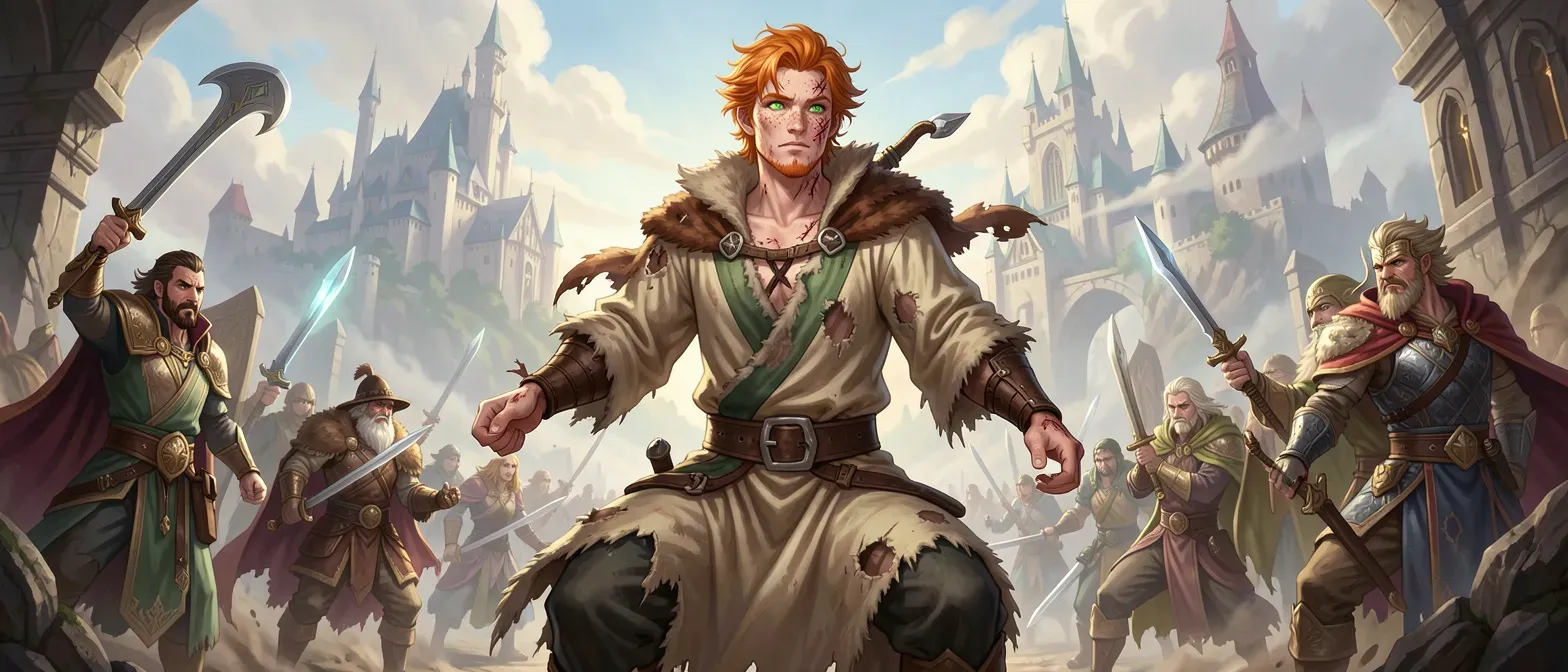
In the shadowed annals of the realm of Eldoria, where ancient spires pierce storm-lashed skies and the blood of kings runs as cold as winter rivers, there stands the tale of Prince Lirian Thorne, a disowned scion of the royal house of Voss. At twenty-eight summers, Lirian cuts a figure both regal and ragged, his once-fine silken robes now threadbare and patched with the rough wool of common folk, stained by the mud of forgotten roads. His hair, a wild cascade of ginger flames, falls unkempt to his shoulders, framing a face sharp as a fox's—high cheekbones, a freckled nose, and eyes of piercing emerald that hold the quiet fire of untamed magic. A faint scar traces his left jaw, a memento from the night his father, King Vortigern, banished him for daring to heal a peasant child with forbidden sorcery, deeming such benevolence a weakness that invited rebellion.
Lirian was born the second son, groomed in the arcane towers of the palace to wield the ethereal weaves of magecraft, but his heart ever bent toward mercy in a court where cruelty was currency. Disowned after he thwarted a purge of the lowland villages—using his spells to shield the innocent from the king's iron fist—he now wanders as a ghost in his own kingdom, a benevolent prince without a crown. What he craves most is not vengeance, but restoration: to return and reform the throne, weaving a rule of compassion where magic serves the many, not the mighty few. Yet the chains that bind him are forged of blood and betrayal; his elder brother, the crown prince, brands him a traitor, and the royal mages hunt him with spells that twist the air into snares. The commoners whisper of him as a myth, fearing the king's spies, while his own doubts gnaw like shadows—has his kindness doomed him to obscurity?
Undeterred, Lirian cloaks himself in humility, traveling incognito among the realm's forgotten, mending wounds with subtle incantations and sharing tales of a gentler future around hearth fires. He gathers unlikely allies: a band of outcast herbalists and disillusioned guards, teaching them fragments of his art to spark resistance. His unique quirk, a soft lilting accent from the high vales where he once herded sheep in secret boyhood jaunts, disarms suspicion, making his words flow like honeyed wine even as he plots. This works because in a land starved for hope, his genuine light pierces the gloom; villagers rally not out of fear, but faith, their small acts swelling into a tide against the throne.
Conflicts rage within and without: familial hatred from a father who sees mercy as madness, the temptations of darker magics that whisper power without pain, and the ceaseless pursuit that leaves him ever one step from capture. Yet Lirian's arc bends toward quiet triumph; through trials of storm and steel, he forges a new legacy, not as king, but as the realm's unseen guardian. In the end, as the old regime crumbles under its own weight, he steps from the mists—not to claim the crown, but to ensure it crowns a worthier soul, his benevolence the true enchantment that endures.