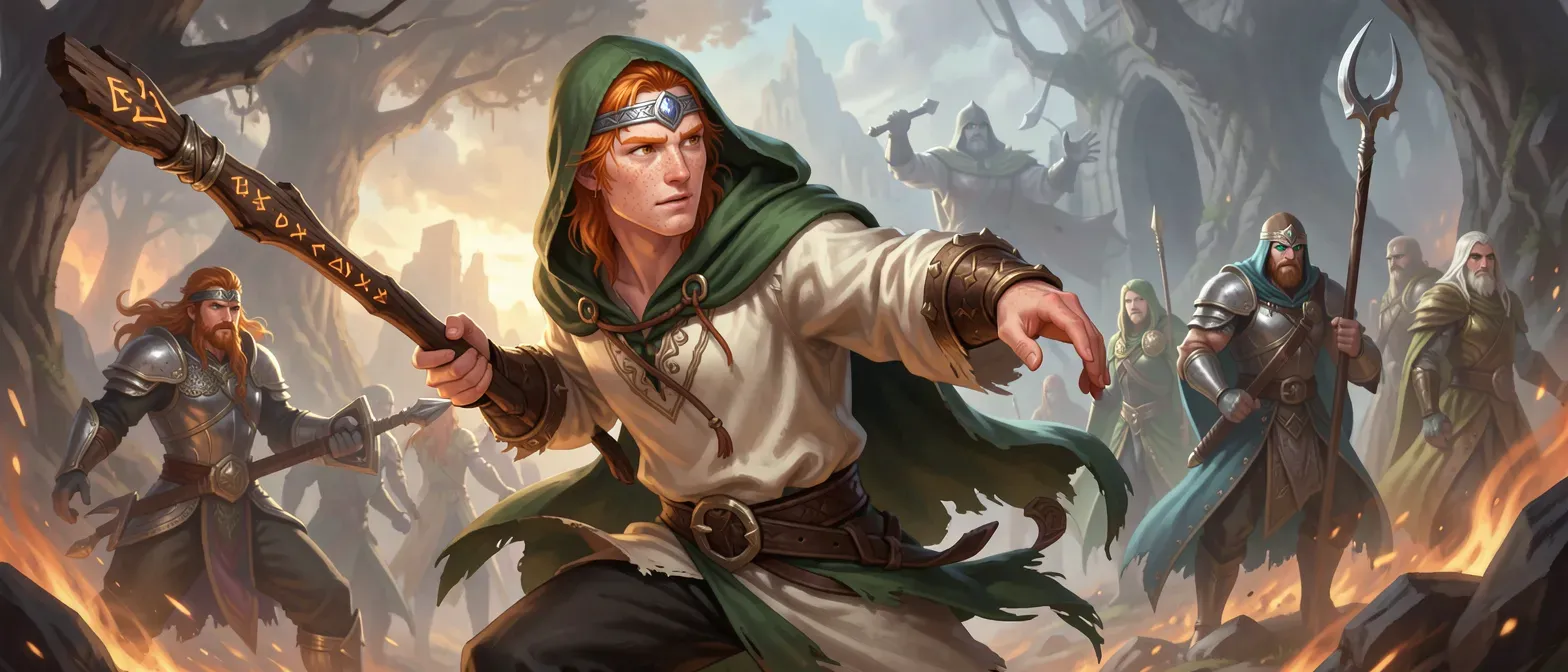
In the shadowed annals of the fractured kingdom of Eldrathor, where ancient spires pierce storm-lashed skies and the air hums with the forbidden pulse of arcana, there strides Elarion Voss, the disowned prince whose fiery mane of ginger hair catches the light like embers in a dying forge. At twenty-eight summers, he cuts a figure both regal and ragged, his once-fine silken tunics now threadbare and patched with the rough wool of common folk, stained by the mud of endless roads and the ichor of spells gone awry. Tall and lean, with shoulders broadened by exile's labors rather than a throne's idleness, his face bears the sharp angles of royal lineage—high cheekbones, a straight nose scarred faintly from a youthful duel—but softened by eyes of warm hazel that gleam with an unyielding compassion, even as freckles dust his pale skin like stars on a twilight canvas. A simple silver circlet, dented and tarnished, clings to his brow, the last remnant of his birthright, while around his neck hangs a pendant of enchanted crystal that pulses faintly with inner light, a talisman against the darkness he both wields and fears.
Elarion was born the second son to King Thornevald, heir to a realm where magic flowed like blood in the veins of the earth, yet was reviled by the crown as a taint upon purity. His benevolence bloomed early, a quiet rebellion against the court's cruelties; he healed the plagued villagers with subtle weaves of light, mended the broken with whispers of restoration, earning whispers of 'the Gentle Flame' among the peasantry. But when a rival lord's intrigue framed his gifts as sorcery bent on usurpation—poisoning his brother's mind with tales of demonic pacts—Elarion was cast out, stripped of title and kin, left to wander the wilds with only his innate arcane affinity for company. What he craves most is not vengeance, but redemption: to return not as conqueror, but as healer, to bind the kingdom's wounds with threads of unity and magic's true grace.
Yet the throne's shadow clings like briars. His family's edicts bar him from the capital, guards hunt him as a traitor, and the wild mages who might ally with him eye his royal blood with suspicion, fearing it dilutes their outlaw purity. Internal tempests rage too—doubts that his mercy is weakness, visions of the brother he once adored now twisted by power's venom. Elarion counters this exile with deeds that echo through taverns and hamlets: he roams the borderlands, cloaked in a traveler's hood of deep green, his staff of twisted oak—carved with runes that glow when he channels verdant energies—guiding him to aid the forgotten. He thwarts bandit raids with illusions that scatter foes like leaves, revives barren fields with rains summoned from his fingertips, and in hidden groves, teaches orphans the controlled spark of magic, fostering a network of grateful souls who whisper his name in the night.
This path endures because his heart's light pierces the gloom; where swords fail, his empathy forges bonds unbreakable, turning enemies to confidants and despair to hope. Conflicts assail him ceaselessly—the ache of lost brotherhood, the moral weight of spells that demand sacrifice, skirmishes with crown enforcers who brand him heretic, and the ever-present lure of darker magics that promise swift justice but threaten his soul. In the end, as prophecies unfold in blood and starlight, Elarion's journey crests not in a crown reclaimed, but in a realm reborn, where benevolence proves mightier than iron, and the disowned prince becomes the architect of a dawn long denied. Yet whispers persist: in his mercy lies a vulnerability, a crack through which old betrayals might yet seep, ensuring his tale remains one of fragile triumph amid eternal strife. His quirk, a soft lilting accent from the northern isles—vowels drawn long like a bard's lament—betrays his origins even in disguise, a melodic cadence that disarms as it enchants.