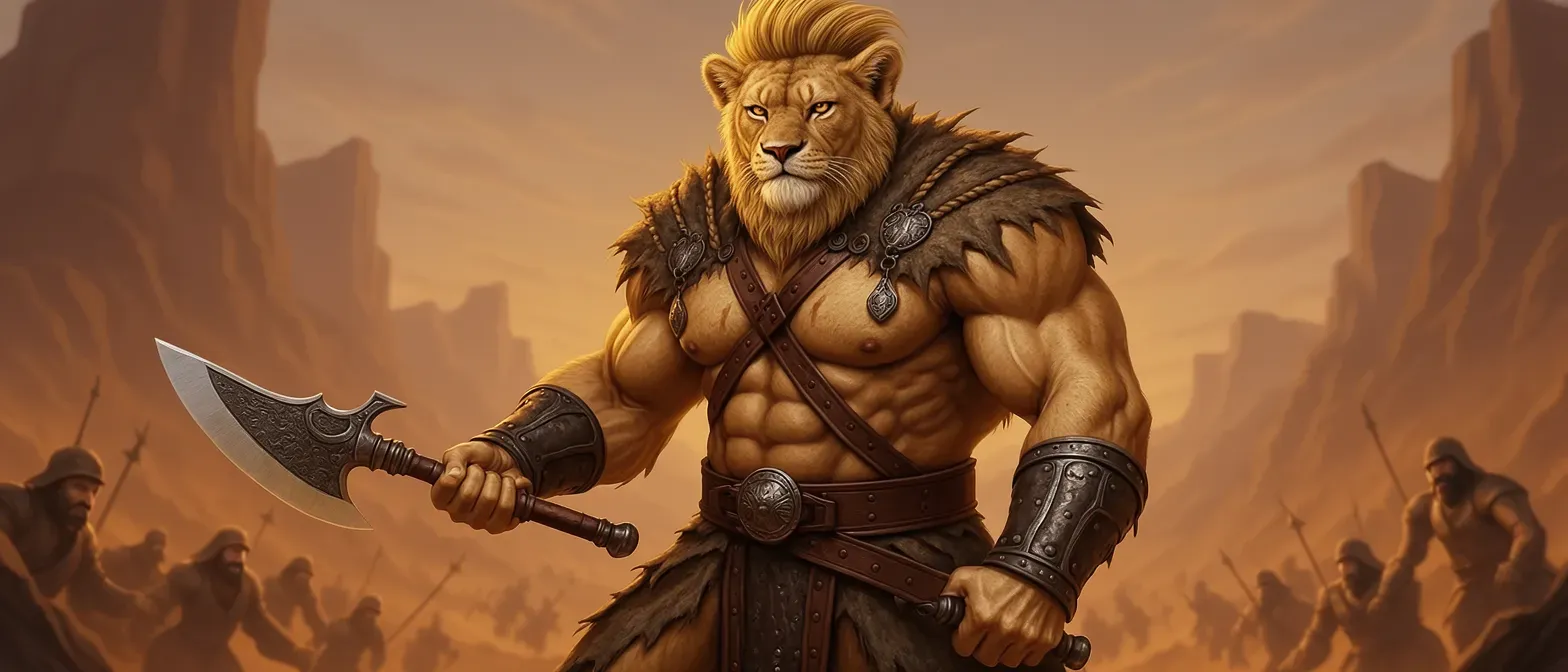
Barac the Unyielding was born under the searing suns of the Leonine Wastes, a vast expanse of cracked earth and jagged obsidian spires where the leonin clans clawed for survival amid endless tribal skirmishes. At thirty-four cycles, he stands a towering seven feet of rippling muscle, his tawny fur scarred from a hundred battles, matted with ritual ash and the blood of foes. His mane, once a proud cascade of golden waves, is now cropped short and braided with the finger bones of slain heretics, framing a face dominated by piercing amber eyes that burn with fanatic fervor. Broad-shouldered and barrel-chested, he moves with the predatory grace of a lion on the prowl, his clawed paws leaving deep imprints in the dust. He wears little more than tattered hides stitched from the pelts of great sandwyrms, adorned with iron talismans etched in the ancient runes of his god, Kharos the Devourer—a deity of raw fury and unquenchable wrath. A massive greataxe, its blade notched from cleaving through armor and bone alike, rests across his back, humming faintly with the divine rage it channels.
From his earliest days, Barac was no ordinary cub; orphaned in a raid by rival clans who spat on Kharos's name, he was raised in the hidden zealot enclaves, where elders whispered of the god's promise: that true believers would rage eternal, their souls reborn in endless battle until the world bowed or burned. Barac wants nothing more than to forge Kharos's empire from the ashes of the unbelievers, to lead his fanatical warband in a holy crusade that will cleanse the Wastes and beyond, making him the exalted Stormclaw, high priest-king of a new age. But the path is barred by the fractured alliances of the leonin tribes, many swayed by false prophets peddling peace or submission to human empires encroaching from the fertile lands to the east. Worse, a creeping doubt gnaws at him—a vision from Kharos itself, showing his fall if he wavers—fueled by the loss of his bond-mate in a botched ambush, her dying roar echoing in his nightmares.
Unyielding, Barac channels this torment into his zealot's path, entering rages that make him a whirlwind of claws and axe, his body shrugging off wounds that would fell lesser warriors, sustained by Kharos's divine fury. He preaches with a guttural roar, his voice a thunderous blend of leonin growls and archaic chants, drawing the desperate and the devout to his banner. In skirmishes, he charges first, bellowing hymns of destruction, his unique quirk a habit of carving fresh runes into his own flesh mid-battle with a ritual dagger, the pain sharpening his divine connection and sending foes fleeing in terror at the sight of blood-script glowing on his fur. This works because his faith is no mere belief but a palpable force; in the Wastes' brutal code, where weakness invites death, Barac's unbreaking will inspires loyalty, turning ragtag zealots into a relentless horde that overruns outposts and shatters coalitions.
Yet conflicts rage within and without: tribal elders decry his extremism as a path to annihilation, while whispers of a greater threat—a shadowy cabal of sorcerers binding ancient evils—test his singular focus. His arc bends toward greater savagery; each victory hardens him, eroding any remnant of mercy, until he stands as Kharos's perfect vessel. In the end, as foretold in fevered dreams, Barac storms the heart of the human citadel, his warband a tide of roaring faithful. He falls pierced by a thousand arrows, but not before his axe drinks the emperor's blood, his soul igniting the pyre that births Kharos's reign—or so the zealots chant, even as the Wastes swallow his broken form, the god's laughter echoing in the wind.