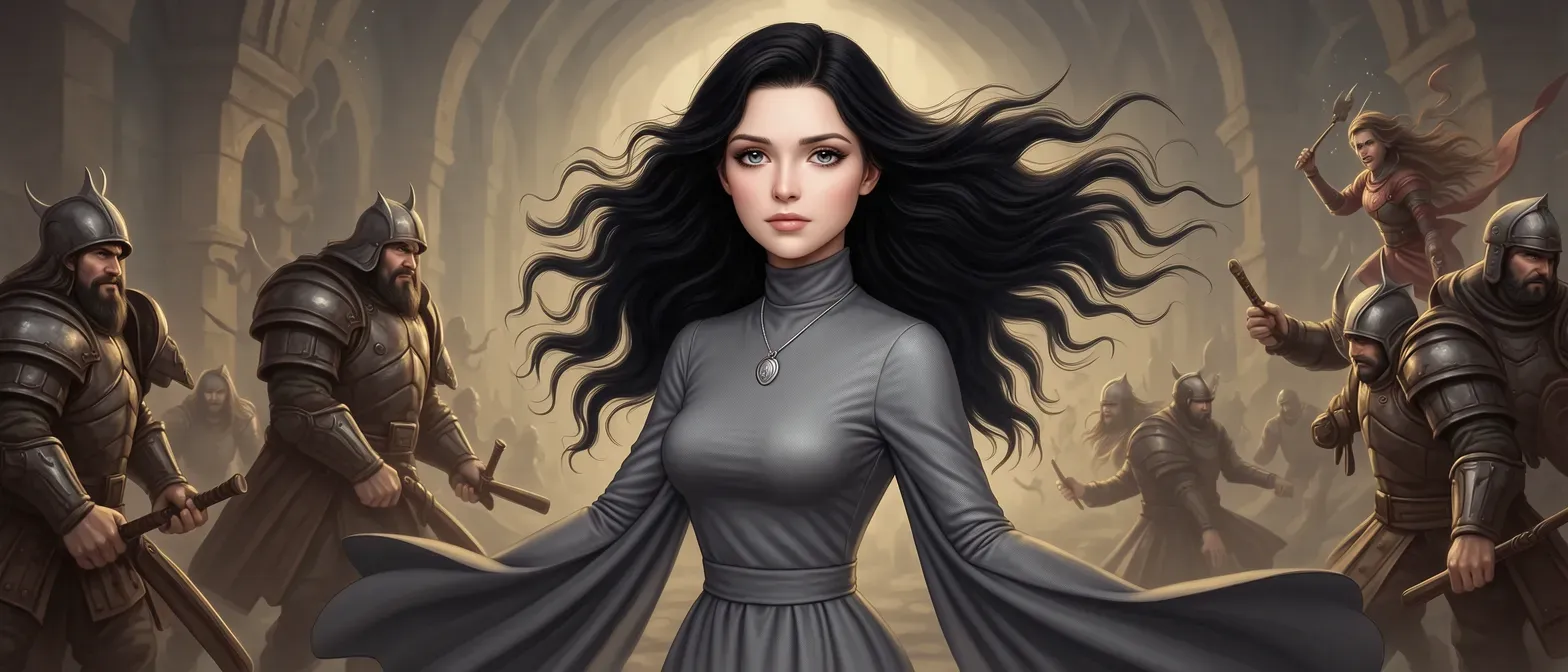
Farren Whitaker was a wisp of a woman, barely twenty-two summers old, with skin as pale as the mist that clung to the moors of her family's crumbling estate in the shadowed vales of Eldridge County. Her hair, a cascade of raven-black waves, framed a face sharp with high cheekbones and eyes the color of storm-tossed seas—gray and piercing, as if they gazed upon realms unseen. She moved with an otherworldly grace, her slender frame draped in the somber grays and blacks of half-mourning silk, the high-necked gown whispering against the floorboards like secrets from the grave. A silver locket, etched with her late father's initials, hung at her throat, a constant talisman against the chill that seemed to follow her.
Born into a lineage of subtle arcane talents, Farren had inherited the gift of spirit mediumship from her mother's side, though it bloomed fiercely after her father, a once-prosperous merchant, perished in a carriage accident three years prior. In the dim-lit parlors of their decaying manor, she communed with the restless dead, their voices a murmur in her mind like wind through cracked windows. But the gift was both curse and solace; it isolated her, marking her as eccentric in a society that prized practicality over the ethereal. Her mother, Lady Elowen, a stern widow with iron-gray hair and a spine forged in desperation, had watched their fortunes dwindle—debts mounting like storm clouds, the estate's fields barren from neglect. To salvage what remained, Elowen arranged a betrothal to Lord Harlan Voss, heir to the Voss shipping empire, a man of thirty with a reputation for shrewd dealings and a cool demeanor that hid deeper currents.
Farren yearned for a life unbound, to wander the spirit-veils freely, perhaps even to aid the lost souls without the chains of matrimony. Yet duty bound her tighter than any spectral tether; refusing the marriage would doom her family to the poorhouse or worse, the scorn of creditors who whispered of hauntings as if her gifts were a blight. She resisted at first, her sessions with the dead growing frantic, seeking counsel from her father's echo, who urged caution in fragmented pleas. But as preparations for the union advanced—fittings for bridal gowns, tense teas with the Voss retainers—Farren found herself drawn into Harlan's orbit. He was no brute, but a puzzle: tall and broad-shouldered, with auburn hair and eyes like polished oak, his voice carrying the clipped accent of the coastal merchants. Their encounters began as formalities, stolen glances across drawing rooms, but simmered into something warmer, a slow unraveling of guards.
Her quirk was a subtle one: in moments of distraction, she'd tilt her head as if listening to an absent conversation, murmuring responses to spirits only she could hear, her fingers tracing invisible sigils in the air. It unnerved servants and intrigued Harlan, who saw not madness but mystery. Conflicts gnawed at her— the spectral warnings of betrayal from jealous kin, the Voss family's skepticism toward her 'hysteria,' and the internal war between her heart's whisper for genuine affection and the pragmatic surrender to security. As winter deepened, their bond kindled like embers in ash: shared walks where she revealed glimpses of the otherworld, his confessions of a lonely youth amid wealth's hollow halls. It worked because patience eroded walls; her vulnerability invited his, turning obligation into choice. In the end, as spring bloomed, Farren wed not in defeat, but with a quiet fire—her gifts honored in their union, the family saved, and a love forged in the slow dance of souls entwined.