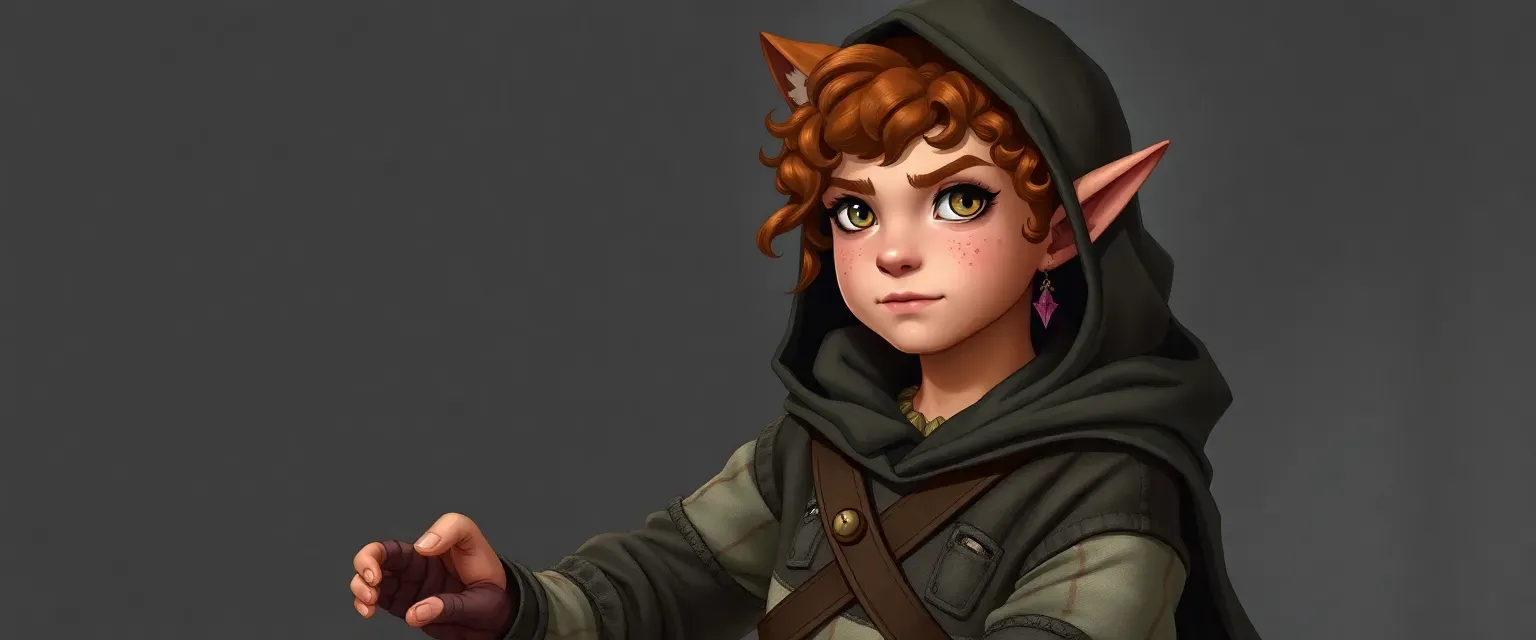
Finnan Underbough was a slip of a halfling, no taller than a man's knee, with the wiry build of one who'd spent his youth dodging chores and slipping through market crowds in the sleepy trading town of Dunborne. At twenty-four, his face bore the sharp, fox-like features of his Lightfoot kin—bright hazel eyes that darted like minnows in a stream, a mop of curly chestnut hair perpetually tousled as if he'd just rolled out of a hayloft, and a smattering of freckles across his snub nose that made him look younger than his years. He favored simple, earth-toned clothes: a patched woolen tunic cinched with a leather belt hung heavy with pouches and a slender dagger, breeches tucked into soft boots that left no print on soft soil, and a hooded cloak the color of autumn leaves to blend into the underbrush. A silver signet ring, pilfered from his ill-fated heist, glinted on his pinky finger—a constant reminder of his folly.
Born in Dunborne, a cluster of thatched roofs and bustling trade wagons numbering barely three hundred souls, Finnan had been the third son of a baker, content with pilfering sweets until ambition soured into desperation. The town’s modest prosperity tempted him; whispers of a merchant’s unguarded strongbox led to his first real score. But the robbery went awry—a guard’s untimely patrol, a dropped coin that echoed like thunder, and suddenly Finnan was fleeing southward under moonless skies, heart pounding as shouts of 'thief!' chased him into the night. Now, in Alnwick, a even tinier hamlet of fishermen and farmers hugging the river’s bend, he scraped by as 'Finn the Fixer,' mending nets and fences by day while his nimble fingers sought easier marks after dark.
What gnawed at Finnan wasn’t the hunger or the isolation, but the ache to reclaim the life he’d torched. He dreamed of returning to Dunborne, not as a fugitive, but a man of means—buying his family’s forgiveness with coin from clever cons, proving he was no mere cutpurse but a survivor with a rogue’s cunning heart. Yet the law’s long shadow loomed; wanted posters with his likeness, crudely sketched, fluttered in Alnwick’s tavern, and old accomplices might sell him out for a bounty. Paranoia was his shadow, manifesting in a unique quirk: a habit of whistling tuneless farm ditties when nervous, a holdover from Dunborne’s fields that betrayed his tension to anyone with ears.
To chase his dream, Finnan wove a web of small schemes—fencing trinkets to traveling peddlers, eavesdropping on river gossip for leads on unattended barges. It worked because his halfling guile was unmatched; he could vanish into a crowd of children or scale a wall like a squirrel, his luck a fragile thread spun from quick wits and quicker feet. But conflicts riddled his path: a budding romance with Alnwick’s miller’s daughter threatened to anchor him, while rumors of Dunborne guards scouring the south stirred old fears. In the end, Finnan’s arc twisted toward redemption’s edge—one final heist on a corrupt lord’s caravan could fund his return, but betrayal by a false friend left him wounded, fleeing deeper into the wilds. There, scarred but wiser, he forged a new path as a wandering scout, his whistling now a defiant melody against the world’s cruelties, forever chasing the home that eluded him.