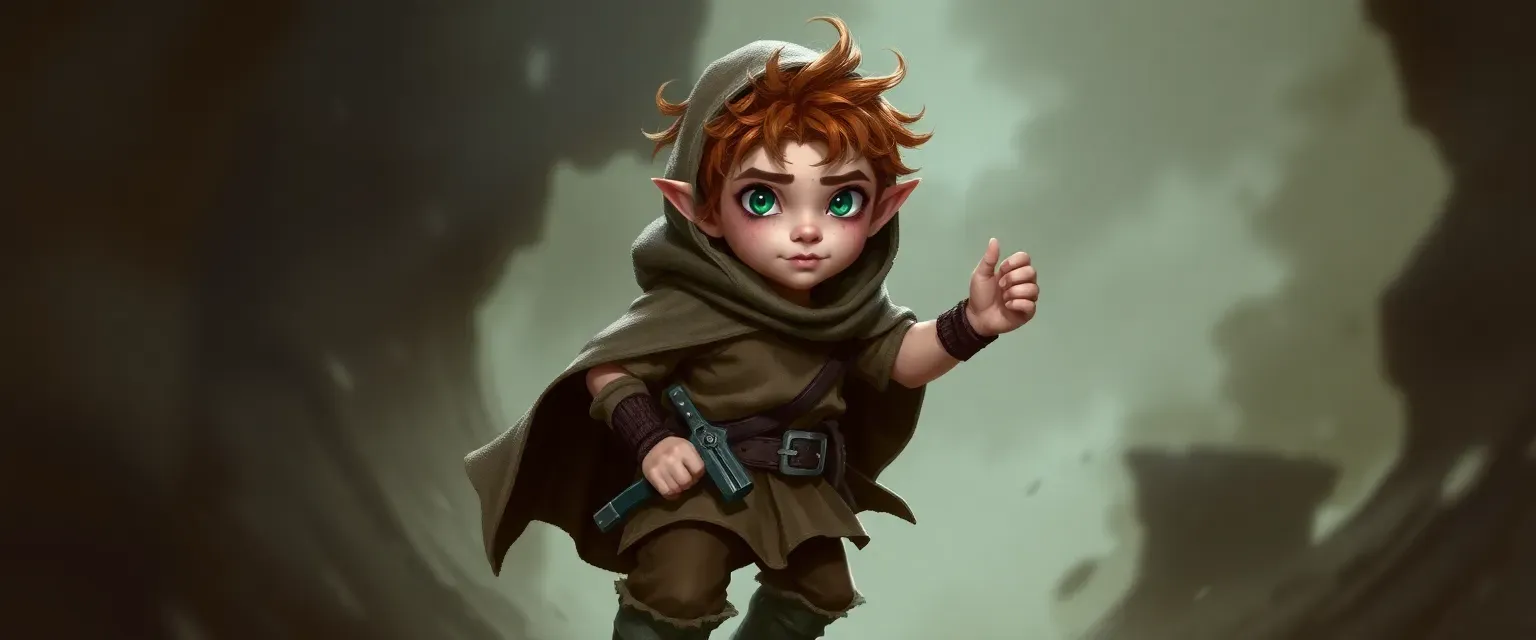
Finnan Underbough was a slip of a halfling, barely three feet tall, with the wiry build of someone who'd spent his life dodging shadows and sharper blades. At twenty-eight years—old enough for a halfling to have a few gray hairs curling at his temples, though his mop of chestnut locks still bounced with boyish vigor—he carried the faint scent of pipeweed and damp earth, a remnant of the rolling hills around Dunborne. His skin was weathered like old leather, freckled from too many suns, and his eyes, sharp green and ever-darting, missed nothing: the glint of a coin in a merchant's pouch or the twitch of a guard's mustache. He favored simple attire for blending in—a threadbare woolen tunic the color of mud, breeches tucked into scuffed boots that whispered rather than clomped, and a hooded cloak patched from better days. A dagger hung at his belt, its hilt worn smooth by nervous fingers, and in his pocket, a lucky copper piece from his first lift, now more talisman than treasure.
Born in Dunborne, that sleepy trading post huddled against the Whispering River, where folk bartered wool and whispers with equal fervor, Finnan had been the third son of a baker whose loaves were legendary but whose temper was fiercer. The town, with its thatched roofs and market square no bigger than a dragon's yawn, bred opportunists like him—lightfoot halflings quick with a smile and quicker with sleight of hand. He wanted nothing more than a life of ease, pockets lined with gold enough to buy a cozy burrow and forget the gnawing hunger of his youth. But a botched robbery at the miller's store—meant to be a simple snatch of silks—had gone sour when a watchman stumbled in early, blade drawn. Finnan fled south to Alnwick, a hamlet even smaller, its cobbled lanes choked with fog and forgotten dreams, where he lay low as 'Finn the Fixer,' mending shoes by day to mask his true trade.
What kept that dream just out of reach was the law's long shadow; whispers of his face traveled on trader's tongues, and every new face in Alnwick felt like a bounty hunter's glare. Paranoia clawed at him, turning allies into suspects, and the small scores he pulled—picking pockets in the tavern or cracking locks on abandoned carts—barely kept the wolves from his door. So he adapted, weaving lies like spider silk: charming the innkeeper's wife for scraps, forging friendships with the local smugglers to fence his hauls. It worked because Finnan was clever, his halfling guile a blade honed by necessity; he read people like open books, exploiting fears and follies with a grin that disarmed before the knife did.
Yet conflicts simmered in his breast like a poorly banked fire. The thrill of the steal warred with the ache of isolation—no family, no roots, just the hollow echo of laughter in empty pockets. Old habits tempted him toward bigger risks, like eyeing the lord's caravan, but the close call in Dunborne haunted his nights, dreams of irons and gallows twisting his gut. In Alnwick, he skirted the edge, building a fragile web of trust, but one slip could unravel it all. His arc bent toward redemption's whisper or ruin's roar; perhaps he'd save enough to vanish to the coast, or maybe the law would catch him mid-lift, ending in a noose that silenced his clever tongue forever. For now, Finnan Underbough danced in the gray, a rogue whose heart beat fastest in the dark.