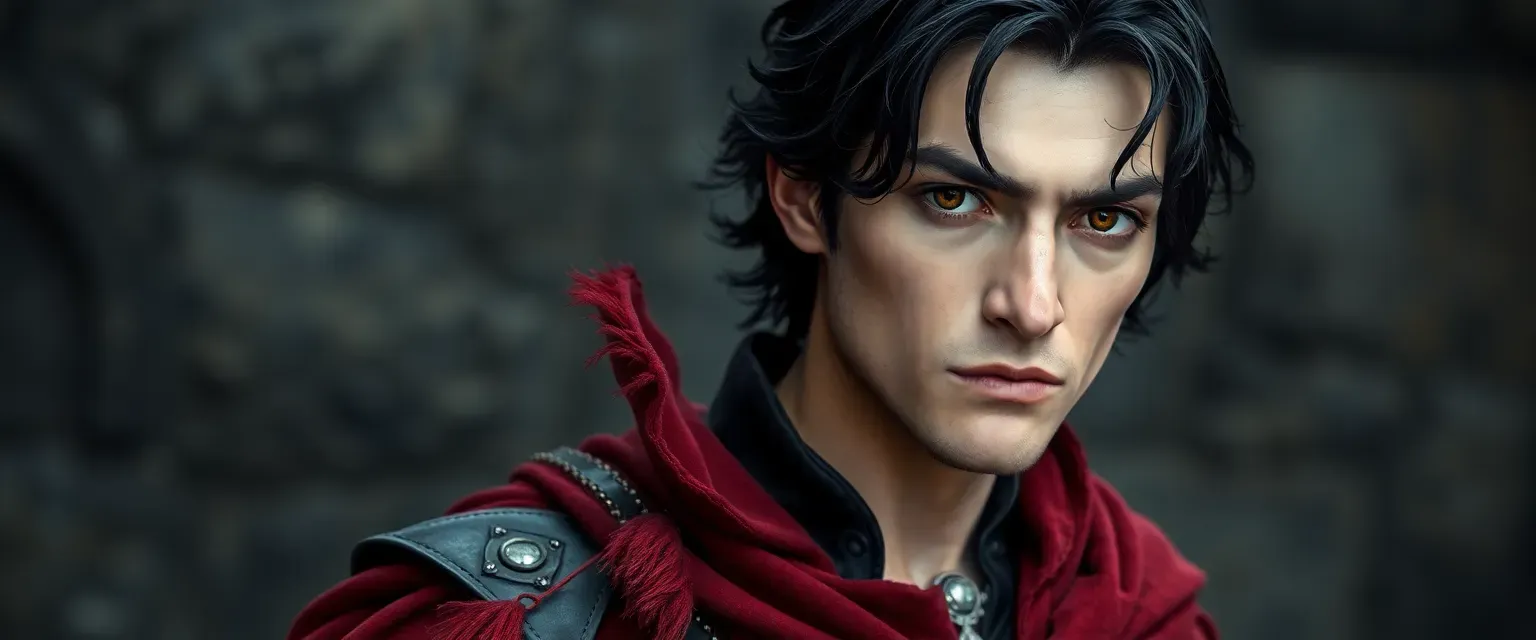
In the shadowed annals of medieval Europe, where the Black Death's scythe still lingered in the mist-shrouded villages, Heskel was born not of woman but of a curse older than the stone cathedrals that pierced the stormy skies. He had been a mere sellsword once, a pragmatic man of thirty summers named Henrik, his face weathered by the ceaseless tramp of armies across the frozen fields of Bohemia. Tall and lean, with skin like polished marble veined in faint blue, his eyes burned with the amber glow of embers in a dying fire—eyes that had seen kings fall and peasants rise, only to tumble again into the mud. His hair, black as raven's wing, fell in unkempt waves to his shoulders, framing a face sharp as a dagger's edge, with high cheekbones and lips perpetually curled in a sardonic half-smile that hid fangs no longer concealed by mortal pretense. He dressed in the faded finery of forgotten nobility: a long cloak of deepest crimson wool, frayed at the hems from centuries of wandering, over a tunic of supple leather reinforced with iron studs, boots caked in the eternal dust of forgotten roads. A silver amulet, etched with runes from a long-lost tongue, dangled at his throat—a quirk of his, this compulsion to hoard talismans from those he fed upon, whispering to them in the dead of night as if they held secrets to his unraveling damnation.
Heskel's nights were a tapestry of calculated shadows, for he was no romantic fiend glutted on gothic tragedy but a survivor honed by the brutal forge of endless undeath. Turned in the fetid crypts of Prague during a plague year, when a dying noble's bite promised eternity but delivered only hunger, he craved above all a semblance of peace—an existence where the bloodlust did not chain him like a rabid dog to the heels of the living. Yet the world conspired against it: vampire hunters with their blessed silver and holy water, rival undead covens scheming in velvet-draped lairs, and the inexorable pull of his thirst that twisted every alliance into betrayal. The medieval realm, rife with feudal wars and inquisitorial fires, offered no sanctuary; peasants whispered of demons in the woods, while lords bartered souls for power, mirroring his own fractured morality.
Pragmatic to his marrow, Heskel navigated this labyrinth not with heroic flourishes but with the cold precision of a chess master in a game of thrones and graves. He forged uneasy pacts with witches in the wildwood glens and mercenaries scarred by the Hundred Years' War, trading secrets of the night for fleeting respites from pursuit. His unique tic—a low, rumbling chuckle that echoed like distant thunder before every deal, born of centuries mocking fate—disarmed foes and allies alike, revealing a mind as sharp as his claws. It worked because he saw the world unvarnished: men were wolves in sheep's hides, and survival demanded shedding sentiment like old skin. He thwarted a cabal of elder vampires in the fog-choked alleys of Vienna by pitting their egos against one another, his riddling words sowing discord like plague seeds.
But conflicts gnawed at him like rats in the walls. Internally, the anti-hero's burden: each life taken chipped at the man he once was, yet mercy invited annihilation. Externally, the Church's relentless crusade and the shifting sands of mortal politics turned every shadow into a potential pyre. In the end, as the Renaissance dawned with its false lights, Heskel vanished into the Carpathian wilds, his quest for peace a pyrrhic echo—thirst sated but soul forever parched, an eternal wanderer whose pragmatic blade carved no victory, only endurance in a world that devoured its own.