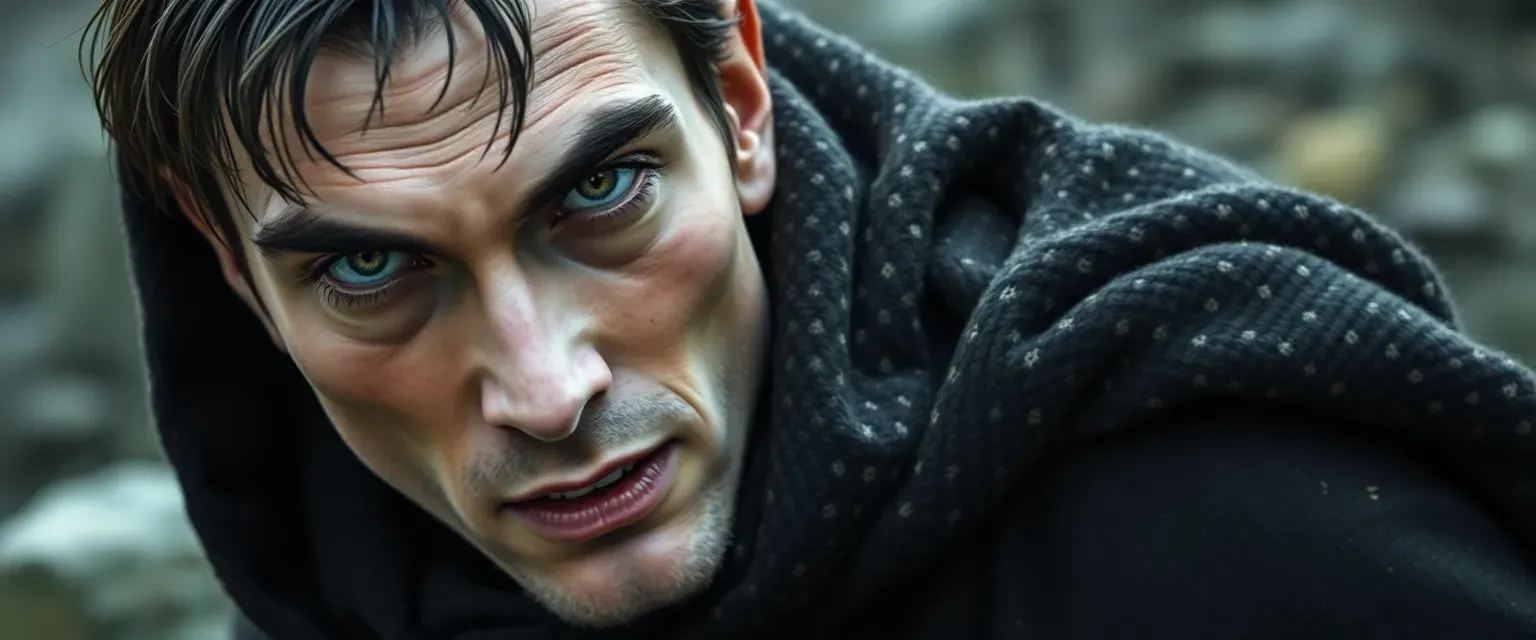
In the shadowed annals of a medieval world where the Black Death's specter still lingered like a foul mist over the thatched roofs of plague-ravaged villages, Heskel prowled the fog-choked forests of Eastern Europe, a figure as timeless as the ancient oaks he haunted. He appeared no older than thirty summers, his skin pale as moonlight on fresh snow, stretched taut over high cheekbones and a jawline sharp enough to draw blood from the careless. His eyes, a piercing gray flecked with crimson, gleamed with the predatory cunning of one who had outlived empires, though his lean frame, clad in a weathered cloak of dark wool lined with faded ermine, spoke of a wanderer fallen on hard times. Beneath the cloak, he wore a simple tunic of roughspun linen, stained with the earth of countless graves, and boots caked in the mud of forgotten roads—garments pilfered from the dead, for Heskel took only what necessity demanded, scorning the ostentation of lesser immortals.
Born a mortal serf in the turbulent days of the 12th century, Heskel had been a blacksmith's son, hammering iron under the lash of feudal lords until a nomadic vampire, fleeing the pyres of the Inquisition, sank fangs into his throat during a raid on his village. Cursed with eternal night, he awoke to a hunger that twisted his pragmatic soul into something sharper, more calculating. No romantic fiend was he; Heskel viewed his undeath not as a tragic gift but a brutal tool for survival in a world that devoured the weak. He wanted dominion over his fate—not the petty thrones of kings, but the quiet power to feed without chains, to navigate the treacherous alliances of werewolf packs and witch covens without bending knee. Yet the sun's merciless gaze and the holy symbols of the Church barred his every step, while rivals—jealous sires and fanatical hunters—hounded him like wolves on a lame stag. The bloodlust gnawed at his reason, threatening to unravel the fragile control he prized above all.
To claim his elusive freedom, Heskel became the anti-hero of whispered tavern tales: allying with beleaguered peasants against tyrannical barons, only to drain the victors in the aftermath; sabotaging witch hunts by turning inquisitors against each other, his interventions as cold and efficient as a surgeon's blade. He counted the heartbeats of his prey before the strike—a peculiar quirk, a rhythmic mantra that grounded his feral instincts, allowing him to strike with precision rather than frenzy. This method worked because Heskel's mind was a forge of intellect, tempering raw vampiric strength with the strategic acumen of a chess master in a game of thrones and shadows. He anticipated betrayals, exploited fears, and turned enemies' zeal into their undoing, all while the world around him festered with superstition and serfdom's unyielding grip.
Conflicts tore at him like thorns in the underbrush: the eternal war between his lingering humanity—memories of a sister's laughter, now dust—and the monster's insatiable void; the clash with a rising order of vampire elders who saw his independence as heresy; and the moral quagmire of his deeds, where saving a village from plague meant culling its survivors to sate his thirst. In the end, as the Renaissance dawned with its flickering lights of reason, Heskel's arc bent toward a pyrrhic sovereignty. He orchestrated the downfall of his sire in a labyrinthine plot involving forged relics and poisoned chalices, claiming a hidden crypt as his sanctum. But victory soured; isolation bred madness, and in the quiet hours, he pondered if true freedom was but another illusion in the endless night, his gray eyes reflecting a world forever changed, yet unchanged in its cruelty.