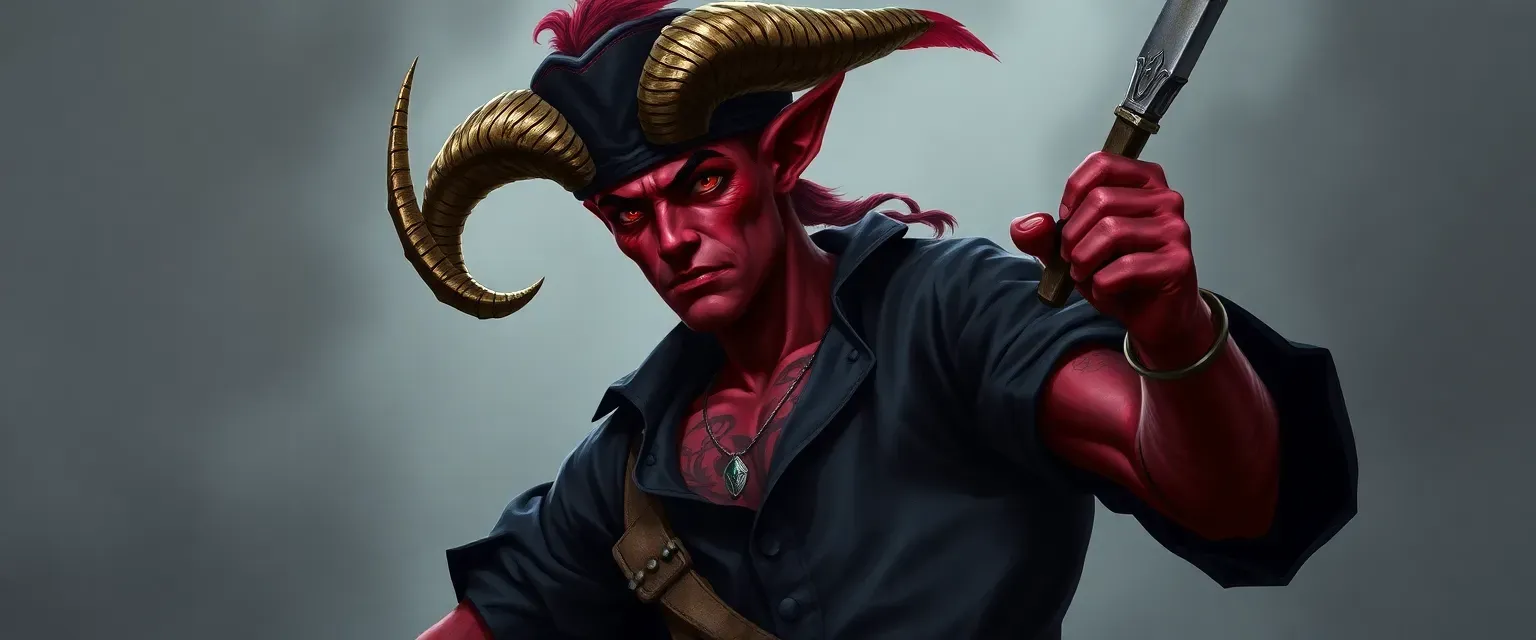
Tharnok Ael'vorn was born under a blood moon in the shadowed alleys of Baldur's Gate, a tiefling whose infernal blood marked him from the cradle with curving ram's horns that twisted like the spires of forgotten devils, and skin the deep crimson of cooled lava. At thirty-two summers, he cuts a striking figure on the deck of his sloop, the Crimson Whisper—tall and lean, with eyes like smoldering coals that flicker with eldritch fire when his patron stirs. His tail, prehensile and tipped with a barbed spade, lashes like a whip in agitation, often coiled around the hilt of his cutlass, a blade etched with runes that hum with otherworldly power. He dresses as a rogue of the seas: salt-crusted leather breeches tucked into knee-high boots scarred by barnacles and blade, a billowing shirt of faded black silk open at the throat to reveal tattoos of coiling serpents and arcane sigils inked in the blood of a kraken he once bested. A tricorn hat, weathered and adorned with a single crimson feather from a phoenix's distant kin, shades his face, and around his neck hangs a locket containing a shard of obsidian—his warlock's pact token, a gift from the ancient entity he calls the Whispering Abyss, a nameless force from the depths that grants him spells of shadow and storm in exchange for whispers of secrets gleaned from the waves.
Tharnok's life is a tempest of rebellion and redemption, driven by a burning desire to plunder the corrupt fleets of the Zhentarim, those iron-fisted merchants who choke the trade routes with their tyranny, enslaving coastal folk and hoarding treasures that could feed nations. He dreams of amassing enough gold to buy a fleet of his own, not for conquest, but to carve out free havens for the outcast—tieflings like him, half-orcs shunned by society, and sailors pressed into service against their will. Yet the sea conspires against him; the Zhentarim's spies infest every port, their warships dog his sails with relentless pursuit, and worse, the Abyss demands tribute in the form of forbidden knowledge, tempting him with visions of power that could twist his good intentions into something darker. Prejudice shadows his every step—dockside mobs hurl stones at his horns, calling him devilspawn, while old crewmates whisper of betrayal when his magic flares unnaturally.
To counter this, Tharnok sails with a ragtag crew of misfits, striking at night with illusions that cloak his ship in fog and bolts of eldritch blast that shatter enemy hulls. He barters with smugglers for maps to hidden coves, sings bawdy shanties to bolster spirits (his voice a gravelly baritone laced with a lilting Isles accent that turns 'r's to rolling waves), and outwits pursuers with cunning feints born of a lifetime evading gallows. His unique quirk is his habit of consulting a cursed spyglass that reveals not just horizons, but fleeting glimpses of alternate fates—a double-edged gift from the Abyss that saves him from ambushes but haunts him with 'what ifs' of lives unlived. This works because Tharnok's chaotic heart thrives in unpredictability; his magic amplifies the wild fury of the sea, turning storms into allies, and his empathy for the downtrodden forges unbreakable loyalties among his crew, who see in him not a fiend, but a brother defying the gods' cruel dice.
Conflicts rage within and without: the Abyss's whispers grow insistent, urging him toward morally gray pacts that test his goodness, while a scarred past—a childhood orphaned by a Zhentarim raid—fuels a rage that blinds him to alliances. His arc bends toward a climactic raid on their flagship, the Iron Serpent, where he seizes a vault of enchanted gold, liberating slaves and scattering the fleet. But victory is pyrrhic; the Abyss claims a piece of his soul, leaving him forever changed, sailing onward into uncertain freedoms, a pirate king haunted by the depths he dances with.