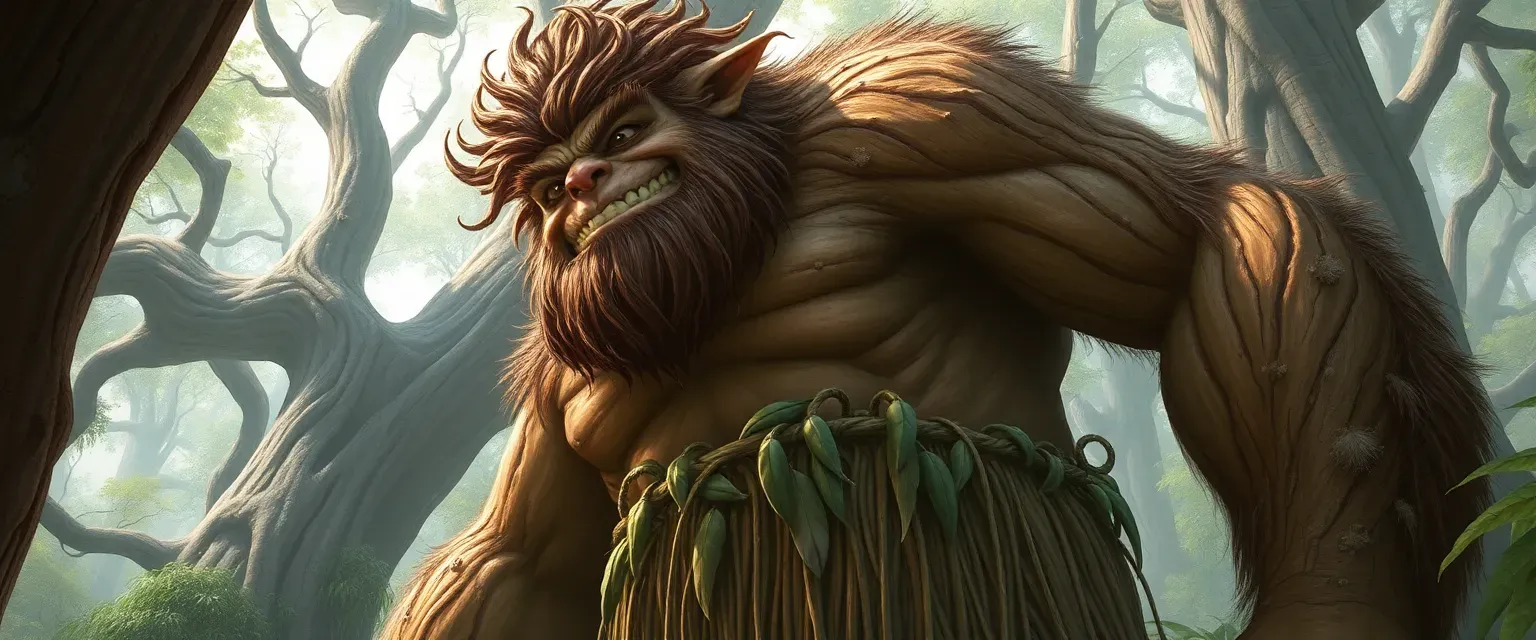
In the shadowed eaves of the Eldergrove, where ancient oaks whispered secrets to the wind, Finbar the forest giant stood sentinel over the western arm, a colossal figure whose laughter echoed like thunder rolling through the canopy. At well over fifteen feet tall, his frame was a living testament to the wild heart of the woods—skin rough and textured like weathered bark, mottled in shades of deep brown and mossy green, with veins of sap pulsing faintly beneath. His hair, a wild tangle of vines and fallen leaves, cascaded down his broad back, and his eyes, bright as sun-dappled pools, twinkled with an unyielding cheer that seemed to defy the encroaching shadows of the world beyond. He wore naught but a loincloth woven from tough reeds and adorned with feathers from the birds he called friends, his massive feet leaving impressions like uprooted stumps in the soft earth.
Finbar was no brooding behemoth of legend; nay, he was a merry soul, his days filled with the lilting tunes he whistled ceaselessly, melodies that wove through the trees like the songs of a hundred hidden songbirds. Born of the forest's own magic in an age when giants roamed free, he had claimed this western reach as his domain centuries ago, after his kin scattered to the four winds in the face of humanity's relentless march. What Finbar craved above all was the enduring peace of his verdant home, a sanctuary where the deer grazed unafraid and the rivers sang clear and pure. Yet that peace slipped through his gnarled fingers like dry leaves, for the axes of men rang ever closer, their villages swelling like tumors on the forest's edge, driven by greed for timber and land.
The loggers came with iron and fire, felling trees that had stood longer than Finbar's memory, and their smoke choked the air he breathed. He could not simply crush them, for the old pacts bound him—blood oaths with the spirits that forbade wanton slaughter, lest the forest itself wither in retribution. Isolation gnawed at him too, a giant adrift in a shrinking world, his cheerful whistles masking the ache of solitude as fewer creatures answered his calls. But Finbar did not yield; he turned his voice into a weapon of subtlety, whistling summons that rallied the beasts—wolves to harry the flanks, birds to blind with swarms of feathers, roots to ensnare wagons in the underbrush. His traps were clever illusions of song and shadow, luring intruders into bogs or thickets from which they emerged scarred but alive, tales of the whistling guardian spreading fear without a drop of spilled blood.
It worked because Finbar's joy was infectious, a balm that bound the forest's fractious life into uneasy alliance; the creatures trusted his tune, seeing in it the pulse of the woods itself. Conflicts brewed within him, though—the temptation to wander east to join distant kin, or the dark whispers of rage that threatened to shatter his pact. In the end, as seasons turned, Finbar's vigilance held the line, the western arm enduring like a scarred but unbroken shield. One twilight, when a great host of men turned back at the sound of his triumphant whistle, he knew his arc was one of quiet triumph, a guardian's endless watch amid the rustle of leaves.