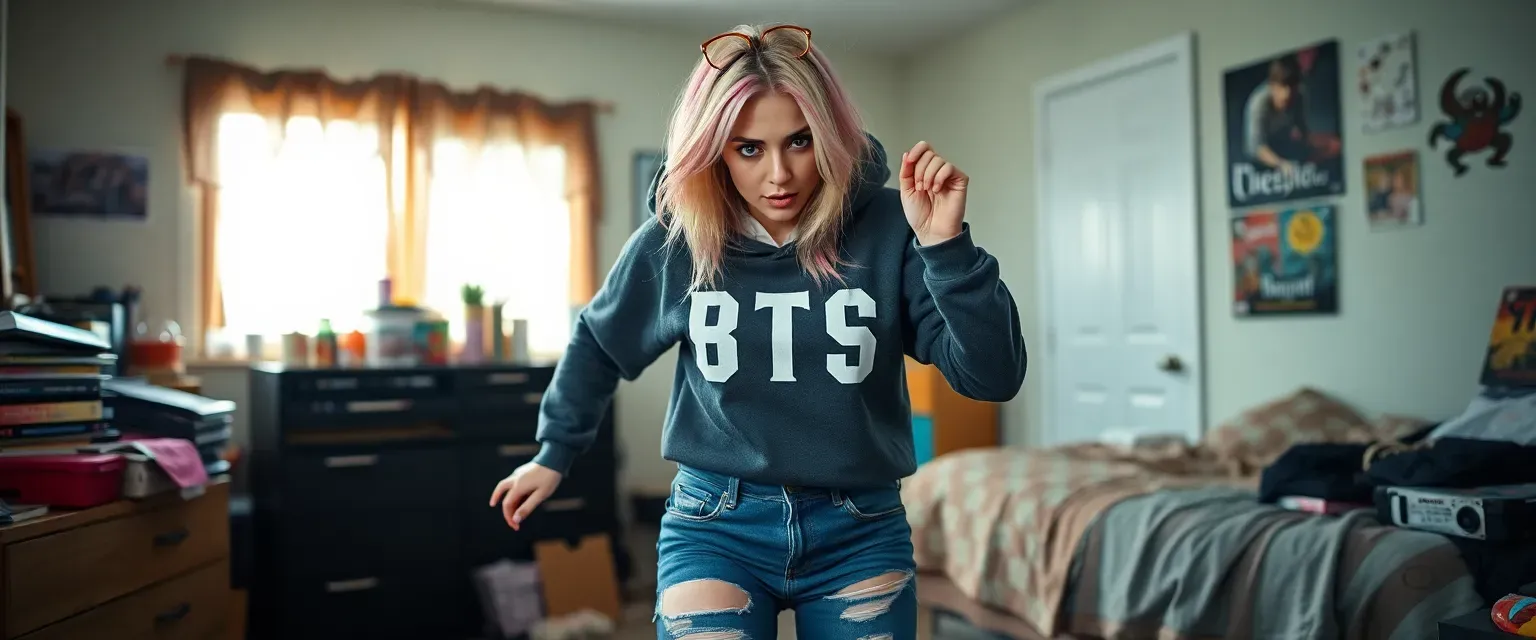
In the dim glow of her cluttered bedroom in a forgotten corner of rural Ohio, Skyla Harlan moved like a shadow puppet strung to the rhythm of distant Seoul beats. At twenty-three, she was a wiry slip of a girl, all sharp angles and restless energy, her frame honed by endless hours mimicking the fluid precision of her idols. Her hair, a chaotic cascade of dyed platinum blonde streaked with faded pink—meant to echo the vibrant aesthetics of BLACKPINK—fell in unkempt waves to her shoulders, often tied back with a scrunchie pilfered from some forgotten K-pop merch haul. Her face was a study in defiant prettiness: high cheekbones smudged with yesterday's eyeliner, eyes the color of storm clouds, wide and hungry, fringed with lashes perpetually clumped from cheap mascara. She favored thrift-store finds twisted into idol cosplay—today, a cropped hoodie emblazoned with BTS lyrics over ripped jeans that hugged her legs like a second skin, and scuffed sneakers that had danced across every inch of her threadbare carpet.
Skyla's world was a shrine to K-pop, posters of TWICE and EXO papering the walls like talismans against the gray drudgery of her life. Born to a mechanic father and a diner waitress mother in this rust-belt town where dreams rusted faster than the old steel mills, she had discovered the glossy escape of Korean pop music at fifteen, courtesy of a pirated video on her ancient laptop. It wasn't just music; it was salvation, a siren call from a land of neon lights and synchronized perfection that made her own existence feel like a bad rehearsal. She wanted nothing more than to shatter the barriers between her and that glittering stage—to board a plane to Seoul, audition for the agencies that birthed stars, and rise from obscurity to idol status, her voice and moves conquering the world.
But the world conspired against her, as it did for every small-town dreamer with stars in their eyes. Money was a cruel joke; her family's debts chained her to double shifts at the local gas station, pumping fuel for truckers who leered and laughed at her muttered Korean phrases under her breath. Talent? She had fire, sure, but her singing cracked under pressure, and her dances, though fervent, lacked the polished edge of those born to it. Cultural chasms yawned wide—English-only auditions online dismissed her as another faceless hopeful, and visas seemed as mythical as the Hallyu wave itself. Her parents, weathered by life's grind, saw her obsession as a phase, a distraction from 'real' paths like community college or the factory line. 'K-pop ain't feedin' you, Sky,' her father would grunt over dinner, his callused hands dwarfing his fork, while her mother sighed about grandbabies and stability.
Undeterred, Skyla fought with the ferocity of a cornered fox. She devoured tutorials on YouTube, her nights a blur of vocal warm-ups and choreography drills until her muscles screamed and her throat burned. She scraped together pennies for a secondhand camera, filming covers in the barn behind the house, the hayloft her makeshift stage amid the scent of damp earth and manure. Online, she built a modest following on TikTok, her unique quirk—a habit of punctuating conversations with improvised K-pop ad-libs, like bursting into a high-pitched 'Eh-oh!' mid-sentence—drawing chuckles and shares. It was her armor, that eccentricity, turning awkwardness into charm, making strangers root for the girl who danced like the devil was chasing her.
Her persistence cracked open doors, slowly but inexorably. A viral video caught the eye of a small indie label scouting talent abroad; invitations trickled in for virtual workshops, then a scholarship to a dance intensive in Chicago. Conflicts gnawed at her—nights of doubt where she stared at the ceiling, wondering if she was chasing fool's gold, or the family rifts widening with every rejected 'normal' job offer. Her father's heart attack forced a brutal choice: stay and care for him, or chase the dream that might never return. She chose the latter, leaving with a tear-streaked goodbye and a backpack stuffed with dreams.
In the end, Skyla's arc bent but didn't break. She landed in Seoul on a shoestring visa, her raw passion earning her a trainee spot at a mid-tier agency. The glamour was grittier than the videos promised—endless critiques, isolation in a foreign tongue, the cutthroat dance of ambition where friends became rivals overnight. Yet it worked because she was unbreakable, her obsession a forge that tempered her flaws into strengths. She debuted not as a superstar, but as a niche sensation, her Midwestern twang-infused Korean raps a quirky hit. The conflicts lingered—homesickness like a thorn, the fear of fading into obscurity—but in the roar of the crowd, she found her place, a hero in her own relentless saga, proving that even from the shadows of Ohio, one could steal the spotlight.