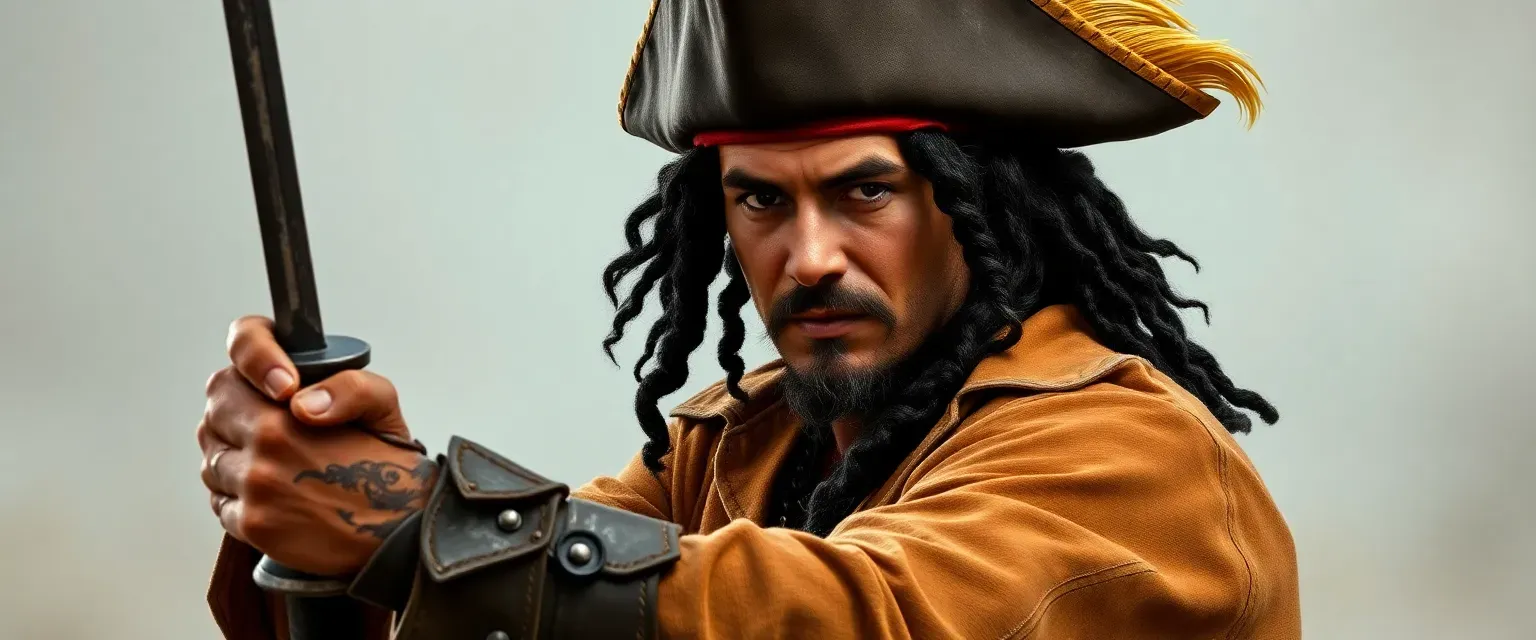
Abraham Ramirez was a man forged in the fires of old-world honor and new-world treachery, his life a tapestry woven from the threads of loyalty shattered like brittle glass under the boot of betrayal. Born in the sun-baked hills of Andalusia in 1682, he was a lad of fierce dark eyes and olive skin, quick with a blade and quicker with his wits, who fled the dusty poverty of his family's goat-herding existence to seek glory in the service of King Louis XIV's France. By twenty-five, he had risen through the ranks of the Musketeers, his lithe frame clad in the blue justaucorps embroidered with silver lilies, a wide-brimmed hat shadowing a face already marked by a dueling scar that curved like a crescent moon from his left temple to jaw. He moved with the predatory grace of a falcon, his voice a gravelly baritone laced with a peculiar quirk—a habit of punctuating his speeches with theatrical flourishes of his rapier, as if every conversation were a fencing match, drawing the blade halfway from its scabbard to emphasize a point before sheathing it with a flourish.
But glory soured into bitterness when, during a skirmish off the Spanish Main in 1707, his regiment was abandoned by the crown's corrupt officers to cover a smuggling operation gone awry. Abraham watched his brothers-in-arms cut down by cannon fire, their blood staining the decks like spilled wine, while he barely escaped with his life, clinging to a piece of wreckage that carried him to the lawless shores of Tortuga. There, the musketeer died, and the pirate was born—El Capitán Ramirez, they called him, his once-pristine uniform traded for a weathered tricorn hat adorned with a single golden plume pilfered from a galleon, a linen shirt open at the throat to reveal tattoos of crossed swords inked in rum-fueled defiance, and breeches tucked into boots scarred by coral reefs and buried treasure hunts. At thirty-five now, his hair hung in black ringlets streaked with premature gray, tied back with a scarlet bandana, and his eyes burned with a hunger that no amount of plundered gold could sate.
What drove him was a venomous thirst for vengeance against the French navy that had forsaken him, a desire to carve out an empire of the seas where no king could touch him, amassing a fleet to strike at the heart of those perfidious courts. Yet the sea, that vast and uncaring mistress, conspired against him; his crew, a ragtag assembly of cutthroats and exiles, whispered of mutiny when spoils ran thin, and the relentless pursuit of royal privateers nipped at his heels like hounds on a fox. Abraham countered with cunning raids on merchant convoys, using his musketeer-honed tactics—ambushes from fog-shrouded coves, feints that turned the tide of battle—to swell his coffers and his legend. It worked because he was no brute pirate but a strategist, his mind a labyrinth of feints and parries, turning the navy's rigid formations against them in bloody ambuscades where grapples and pistol fire decided fates.
Conflicts gnawed at him like shipworms in the hull: the ghosts of fallen comrades haunted his rum-soaked dreams, urging a return to honor he could no longer afford, while temptations of amnesty from old allies pulled at his resolve. His arc twisted through storms of moral ambiguity, from a man who once pledged 'one for all' to one who trusted none, his villainy not in mindless cruelty but in a cold calculus that justified drowning innocents for the greater strike against his betrayers. In the end, as cannon smoke choked the horizon during his audacious assault on a French frigate off Brest in 1715, Abraham's blade claimed the admiral's head, but a stray ball found his chest. He died on the blood-slick deck, grinning through the pain, his empire dissolving into the waves, a pirate's requiem sung by the wind—free at last, but forever chained to the sea's indifferent embrace.