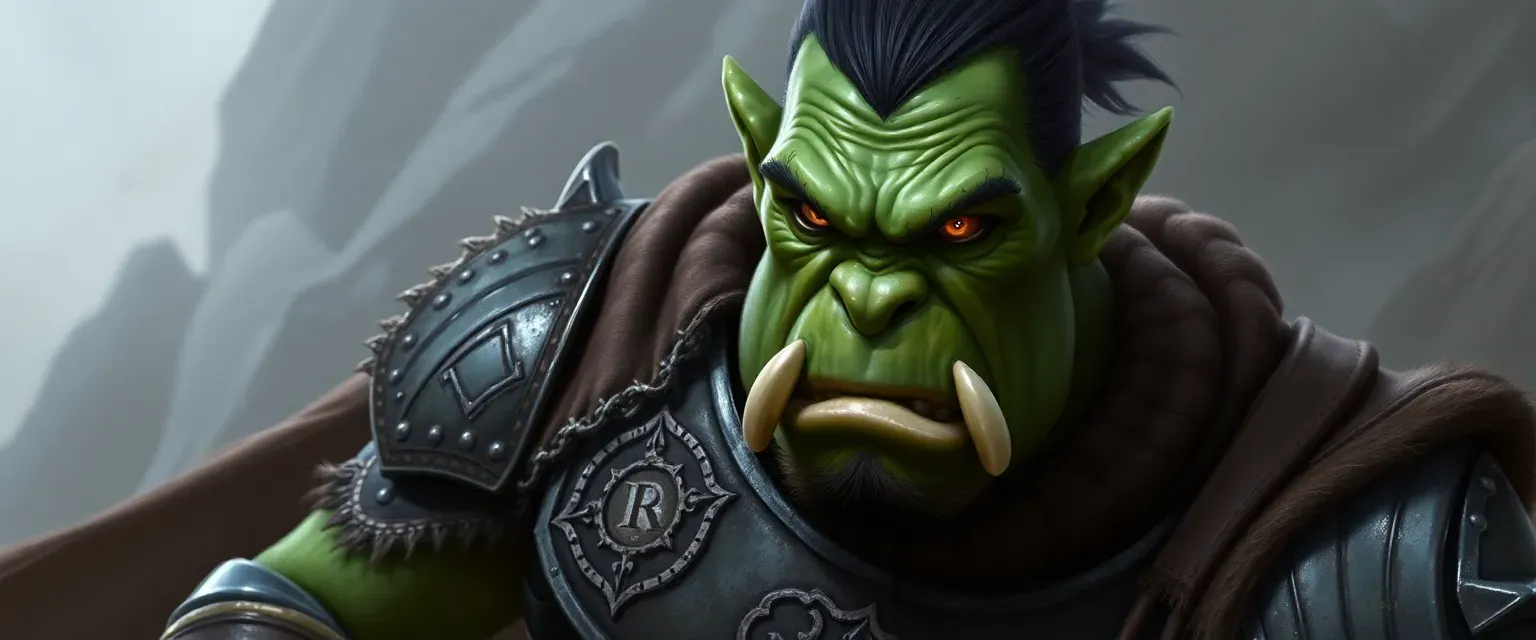
In the shadowed crags of the Spine of the World, where the wind howls like the rage of forgotten gods, Thulak Grothir was born under a blood moon, sixteen summers past, to a tribe of orc raiders who knew only the ceaseless drumbeat of war. He stands at six feet of raw, unhewn muscle, his green skin scarred from ritual floggings and accidental tumbles down rocky slopes, tusks jutting unevenly from a jaw that seems perpetually clenched in frustration. His eyes, a piercing amber, burn with the fervor of one who has glimpsed divine fury, yet his broad shoulders slump slightly, as if the weight of his own ambitions presses him earthward. Clad in modest leathers patched with hides from beasts he claims to have slain—though whispers suggest otherwise—Thulak wears a dented breastplate etched with crude symbols of Gruumsh, the One-Eyed God, and wields a longsword that he's dropped more times than he's swung it true. A simple cloak, frayed at the edges, billows behind him like a beggar's banner, and around his neck hangs a pendant of polished obsidian, said to hold a shard of Gruumsh's rage.
Thulak fancies himself a paladin, sworn to the Oath of Devotion, but his vows twist like thorns in the orcish heart—devotion not to light or justice, but to the chaotic storm of destruction that Gruumsh demands. From his sage background, gleaned from pilfered tomes in raided elven libraries, he hoards knowledge like a dragon its gold: arcane runes, battle tactics, the weaknesses of lesser races. Yet clumsiness plagues him, a curse he attributes to Gruumsh's test of worthiness. He stumbles over roots in the underbrush, fumbles holy symbols during rituals, his massive hands better suited to crushing skulls than delicate incantations. This quirk, this perpetual awkwardness, manifests in a halting speech pattern, words tumbling out in a gravelly orcish accent laced with unintended pauses, as if even his tongue conspires against him.
What drives Thulak is a burning vision: to lead his tribe to glory, sacking the soft cities of humans and elves, proving himself the chosen vessel of Gruumsh's wrath. He dreams of altars slick with the blood of the weak, of forging an empire from the bones of the conquered. But youth betrays him; at seventeen, he's dismissed as a whelp by grizzled chieftains, his clumsiness a jest around campfires. The oath binds him too—its tenets of honor and protection chafe against his evil impulses, forcing him to aid the very weaklings he despises, all in the name of a 'greater devotion' to the god's unpredictable will.
He schemes in the shadows of his modest tent, poring over maps by flickering torchlight, allying with opportunistic goblins or seducing tribal outcasts with promises of plunder. His intelligence shines here, a sharp mind weaving plots that ensnare foes before his blade ever draws blood. He orchestrates ambushes with surgical precision, using knowledge of terrain and enemy habits to compensate for his physical torpidity. It works because Thulak's evil is not brute force but cunning malice; he turns his flaws into feints, luring overconfident adversaries into traps where his devotion manifests as fanatical zeal, smiting with divine fury when least expected.
Conflicts rage within: the tribe's elders mock his 'bookish' ways, seeing sage pursuits as weakness, while the oath's pull wars with his chaotic urges, birthing nightmares of divine retribution. Betrayals fester— a rival warrior eyes his position, and whispers of heresy swirl, for how can one so devoted to destruction claim paladin's grace? His arc spirals deeper into villainy, each victory hardening his heart, twisting devotion into obsession. He will not redeem; instead, he will rise, a clumsy colossus of chaos, until the world kneels or burns. In the end, Thulak envisions himself atop a mountain of skulls, Gruumsh's eye upon him, his clumsiness shed like old skin in the fires of conquest. But for now, he trudges on, a young orc whose genius lurks beneath the falls, waiting to unleash hell.