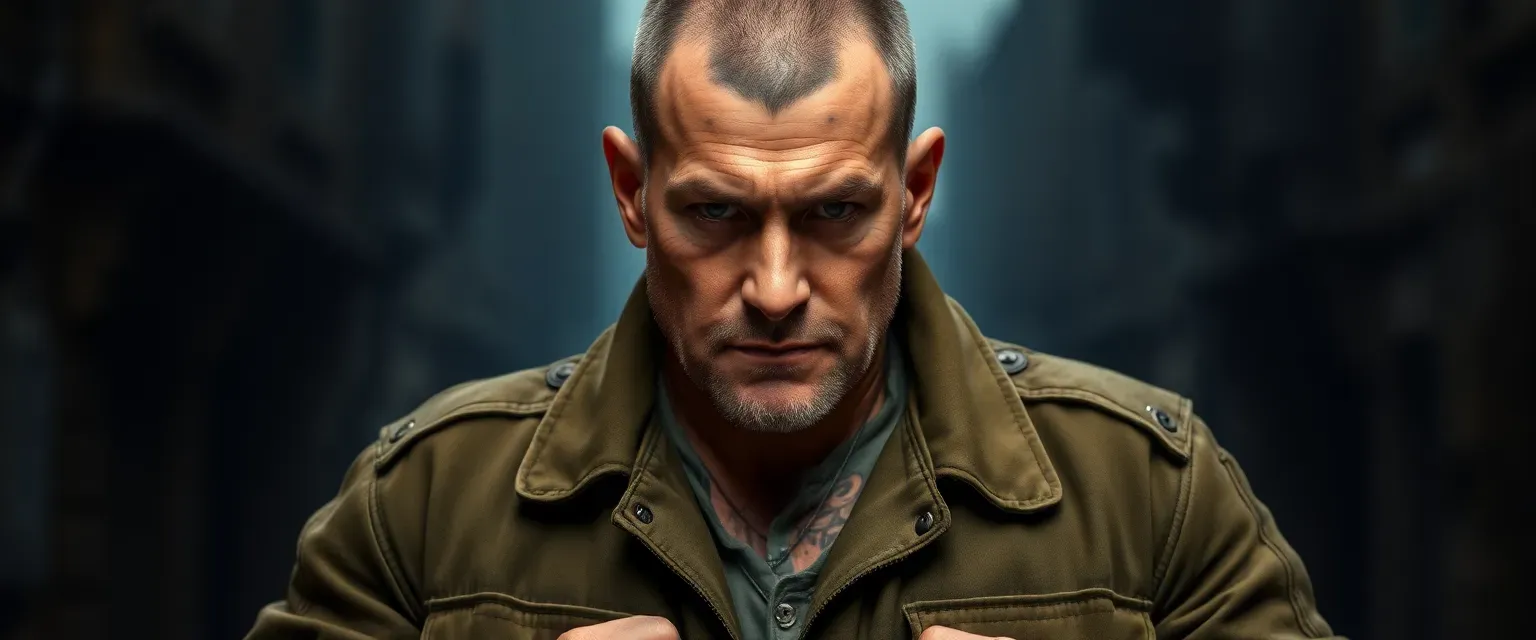
In the shadowed underbelly of a nation fractured by its own secrets, Captain Elias Thorne stands as a bulwark against the encroaching tide of tyranny, his life a tapestry woven from threads of unyielding loyalty and quiet heroism. At forty-two, Elias cuts a figure both imposing and weathered, his broad shoulders straining against the faded olive drab of his surplus military jacket, patched and reinforced from years of hard use. His face, etched with the fine lines of a man who's stared down death more times than he cares to count, bears a jagged scar that runs from his left temple to the corner of his mouth, a souvenir from a botched op in the badlands where the government's black-site experiments first leaked into the wild. Steel-gray eyes, sharp as bayonets, peer out from beneath a cropped salt-and-pepper buzz cut, and his hands—callused, ink-stained from old tattoos of forgotten regiments—clutch a battered thermos of black coffee like a talisman against the endless nights.
Elias was born in the rusting heart of the industrial Midwest, son of a factory worker and a nurse who taught him that goodness wasn't a luxury but a duty, even when the world conspired to crush it. He enlisted young, rising through the ranks on a diet of grit and principle, only to watch the military he loved twist into the government's iron fist, hunting down anomalies like Aiden Foster's daughter, little Elara, whose budding powers could unravel realities or forge new ones. Aiden, his old squad mate from the dust-choked wars abroad, had reached out in desperation two years back, begging Elias to shield the girl from the faceless agents who saw her not as a child but as a weapon. What Elias wants, more than breath itself, is a world where innocence isn't collateral—where Elara can grow without the shadow of labs and interrogations looming. But the system he once swore to uphold now hunts him too, branding him a traitor for every safe house he provides, every forged ID he slips into the underground networks.
The barriers are ironclad: surveillance drones hum like vengeful hornets over the cities, informants lurk in every diner, and Elias's own lingering oaths pull at him like phantom chains, whispering of courts-martial and disgrace. His body betrays him too—a chronic ache in his knee from that long-ago shrapnel, flaring with every evasion sprint through rain-slicked alleys. Yet Elias fights on, his unique quirk a soft, rhythmic tapping of his fingers against his thigh, mimicking the Morse code for 'hope' he learned in basic, a private rebellion that steadies his nerve amid the chaos. He orchestrates diversions with precision—leaking false trails to draw off pursuers, rallying a loose cadre of disillusioned vets who owe him favors from darker days. It works because Elias knows the machine's gears intimately; he's oiled them, jammed them, bled for them. His intelligence isn't flashy but tactical, born of battlefields where one wrong move meant graves unmarked.
Conflicts gnaw at him relentlessly: the gnawing guilt of abandoning his post, the fear that one slip could doom Aiden's family, and the creeping isolation as old comrades turn away, their eyes hollow with complicity. In quiet moments, staring at the stars from a hidden bunker, Elias wonders if he's just delaying the inevitable, if the government's reach will swallow them all. But then Elara's laughter echoes—innocent, unscarred—and he steels himself anew. His arc bends toward redemption, not through grand gestures but persistent shadows, culminating in a final stand at the borderlands, where he buys their escape with his freedom, vanishing into legend as the soldier who chose heart over homeland. Elias Thorne endures, a good man in a machine that devours the good, proving that even in the jaws of empire, one soul can shield the light.